
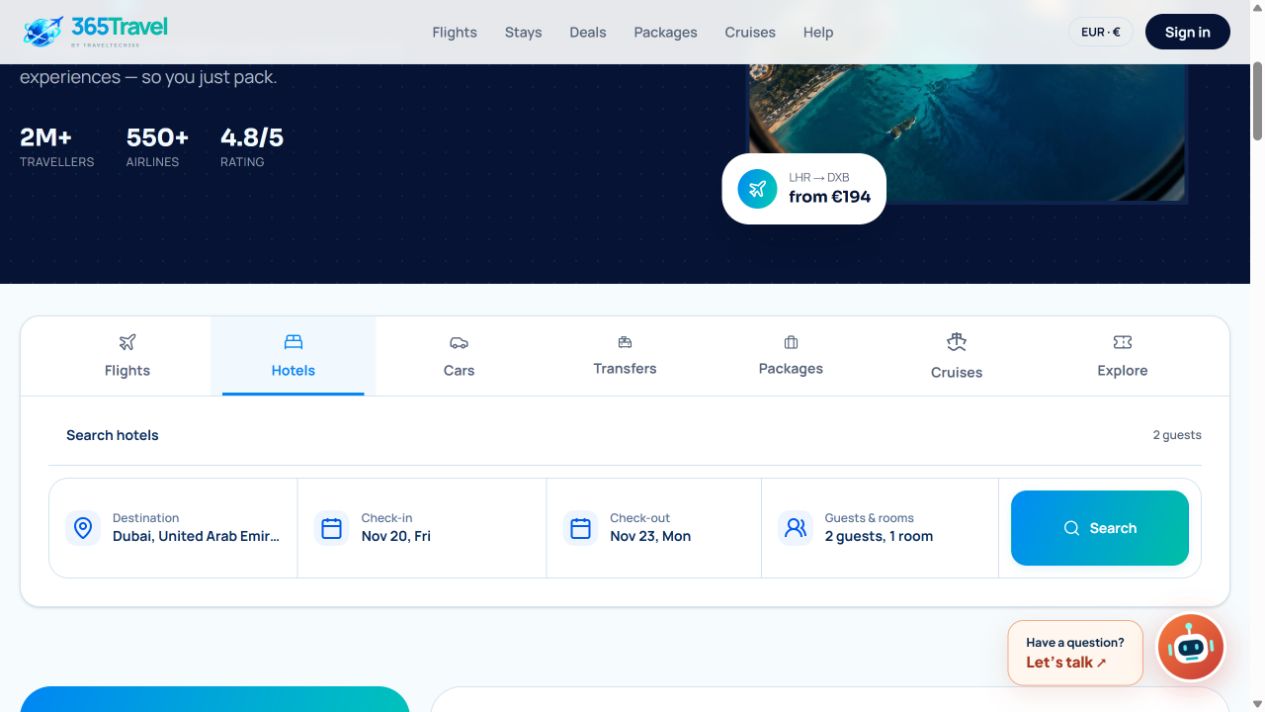
For implementation examples, explore custom travel portal development, the white-label OTA approach and the travel portal development cost guide.
Custom Travel Portal vs White Label: Choose the Operating Model, Not Just the Website
Choosing a custom travel portal vs white label platform is not simply a design decision. It determines who can change a booking workflow, how new suppliers are connected, what happens when a contract ends, and which team is responsible when something breaks. Identical-looking portals can create different obligations for the agency.
A white-label platform generally provides an existing product that a travel business configures and presents under its brand. A custom portal is developed around defined business requirements, with architecture, integrations, and operating processes agreed for that project. Neither label guarantees source-code ownership, unrestricted API access, lower costs, or better performance. Those details depend on contracts and implementation choices.
The useful question is which model gives the business enough control without unmanageable complexity. This guide compares the boundaries, costs, dependencies, and exit risks shaping that answer.
What Each Model Actually Means
White label: an existing product with configurable surfaces
A white-label travel portal typically starts with a provider-maintained booking application. The agency may set its logo, domain, colors, content, customer-facing messages, payment preferences, markups, and available modules. The exact options depend on the provider's administrative controls and agreement.
The provider usually decides the underlying product roadmap, core data structures, release cadence, and limits of supported customization. Some suppliers offer APIs, plugins, dedicated environments, or paid changes; others expose only a restricted dashboard. Calling both products “white label” does not make their flexibility equivalent.
Custom: requirements shape the application and processes
A custom travel portal starts by specifying what the business must do: which users can book, how approval and quotation work, what inventory is displayed, how prices are calculated, and how bookings move through support and finance. Developers then build or assemble the required capabilities, often using external travel APIs and established software components.
“Custom” does not mean building every component from zero. It also does not automatically mean the client owns every line of code. A development contract may grant an exclusive assignment, a perpetual license, or a limited right to use the delivered system. The distinction must be written down before development begins.
Hybrid: extend a platform where it matters
A third route combines a configured booking core with separately developed features such as a corporate approval layer, CRM connection, reporting workspace, or customer application. This can avoid rebuilding standard search and booking functions while allowing differentiation elsewhere.
Its main risk is the seam between systems. Before choosing a hybrid, verify the booking platform exposes stable integration interfaces and permits the intended external workflows, data exchange, and branding.
Configuration vs Development: Where the Boundary Sits
A feature is configurable when an authorized user can change it through supported settings without modifying the product's underlying behavior. It becomes development when new logic, data structures, interfaces, or integrations must be engineered, tested, and maintained. The boundary matters because a sales demonstration may show a visible outcome without revealing how constrained that outcome is.
Ask how a change is made, not merely whether it is possible
Consider a request to apply a special margin to hotel bookings for a particular agency. One platform might offer a rule in its admin panel. Another may require a provider support ticket. A custom system could implement the rule, but someone must design the conditions, test conflicts, and maintain it when supplier responses change.
Label each requirement available now, configurable, extension supported, custom development required, or not supported. Require a demonstration rather than a general promise of flexibility.
Test the difficult cases before the attractive ones
Standard one-way search and checkout may work well in either model. Differences often emerge in agency credit limits, multi-level approvals, partial cancellations, split payments, negotiated fare display, offline quotations, passenger amendments, and exception handling. Ask who can alter each process, what triggers extra fees, and which changes need a release.
Example — illustrative: A corporate client wants an employee to request a flight, obtain a manager's approval, and then allow a travel consultant to issue it. A platform that supports only immediate payment may require a workaround. A custom or extensible system can be designed around the approval steps, subject to supplier ticketing constraints.
Branding and Change Flexibility Beyond the Logo
Brand control exists on several levels. The visible layer includes colors, typography, imagery, page composition, emails, and domain names. The interaction layer governs navigation, mobile booking steps, account creation, promotions, and post-booking actions. The business layer governs eligibility, pricing, approvals, and support operations.
White-label products can be excellent at visible branding while limiting changes to search cards, passenger forms, or checkout order. Conversely, a custom build can support an original experience but create inconsistency if nobody funds design maintenance. A distinctive interface still needs reliable booking.
Run a brand acceptance test
Show the same mobile journey in both proposals: homepage, search results, product details, passenger details, payment, confirmation, and manage-booking. Check responsive behavior, language handling, accessibility, error messages, and the names appearing on transactional emails. Do not stop at a branded landing page.
Also ask whether your team can publish landing pages, control canonical URLs, edit structured content, and measure conversion events. If a future provider migration is possible, preserving stable content URLs and domain administration becomes a business concern, not simply an SEO task.
Ownership, Control, and the Right to Leave
“You own your portal” is too vague to evaluate. Separate ownership of the domain, brand assets, original content, customer and booking records, newly developed source code, deployment configuration, third-party libraries, and supplier contracts. Each asset may have a different owner or license.
Specify the assets you can actually take away
For a custom build, determine whether the client receives repositories, build instructions, environment configuration, database schema, API documentation, test suites, and sufficient rights to maintain the project with another developer. Exclude provider secrets and third-party code that cannot lawfully be transferred. For a white-label service, specify accessible data exports, required notice periods, transition support, and continued access during the handover.
Protect domain control separately. ICANN's guidance on domain transfers explains registrant transfer rights and the importance of being the registrant of record or administrative contact. Keeping the domain registered under the business's authorized control simplifies an otherwise stressful exit.
A downloadable spreadsheet is not a complete migration plan
Ask for sample exports of traveler profiles, consent indicators, agency accounts, quotes, booking references, payment statuses, invoices, cancellations, support notes, and audit trails. Verify which fields are included, how often exports can run, whether attachments are retrievable, and how records relate to one another.
Privacy law and commercial data exit rights are different questions. The European Commission's data portability guidance describes an individual's right in qualifying circumstances; it is not a substitute for a business-to-business contract that guarantees full operational exports.
Plan continuity for customers and search traffic
When changing URLs, preserve a mapping of old pages to relevant new pages and plan redirects, internal-link updates, and sitemap changes. Google Search Central's site-move guidance documents those steps and warns that search visibility can fluctuate during a move.
Operational continuity matters just as much. Decide who will service bookings created on the old platform, how travelers access confirmations, and where refunds and chargeback evidence remain available after the cutover.
Supplier Dependencies Do Not Disappear With Custom Code
Flight, hotel, activity, transfer, and car rental inventory comes with commercial and technical rules. A custom front end does not create airline accreditation, supplier permissions, preferential fares, or entitlement to booking and servicing APIs. A white-label provider may bundle certain connections, but must still clarify whose credentials, agreements, and settlement processes apply.
Separate access, capability, and responsibility
For every desired source, record who signs the supplier agreement; who holds credentials; which markets and products are authorized; who handles payment and fulfillment; and which servicing functions are actually enabled. Distinguish search-only content from live pricing, booking confirmation, ticketing, changes, cancellation, and refunds.
For airline retailing, IATA describes NDC as an industry data exchange standard built around offers and orders. A standard helps define communications; it does not itself grant a particular agency an airline connection or ensure every airline implements identical workflows.
Evaluate how hard it is to replace one supplier
Suppose a hotel aggregator changes its response format, commercial terms, or available inventory. A tightly coupled portal may need changes across search, pricing, booking, and reporting. A design with a documented supplier adapter can limit the affected area, although replacement still requires development, supplier onboarding, and regression testing.
Ask vendors to demonstrate error mapping, retries, timeouts, price revalidation, duplicate booking prevention, and clear ownership of failed transactions. These operational details are more informative than counting logos on an integrations page.
Lifecycle Costs: Compare the Whole Operating Period
A small setup fee and a large build budget cannot be compared without specifying the period, scope, usage, and responsibilities. Both models have initial, recurring, variable, change, and exit costs. None is universally cheaper: commercial terms, transaction mix, team capability, and the need for differentiation determine the answer.

Common white-label cost categories
Review onboarding, configuration, subscriptions, user or agency seats, booking or transaction charges, supplier-related fees, payment gateway charges, customization requests, premium support, additional environments, data exports, and termination assistance. Clarify minimum commitments and whether transaction fees apply to cancellations, failed bookings, or refunds.
A bundled price may simplify vendor management, but it can also obscure which party pays for enhancements or changing demand. Ask for an itemized commercial schedule and written examples of how invoices are calculated, without assuming the most favorable usage pattern.
Common custom-development cost categories
Include discovery, design, development, third-party licenses, integration onboarding, testing, security review, hosting, monitoring, backups, ongoing maintenance, regression testing, supplier changes, documentation, and support staffing. Reserve time for business owners to review requirements and approve releases; their involvement is a real operating cost even when it is not invoiced by a developer.
Custom builds can avoid some vendor constraints, yet every bespoke exception becomes something a team must understand and test. Ownership without maintenance capacity can be a liability rather than an advantage.
Use a comparable cost model, not invented price benchmarks
Choose the same evaluation horizon and forecast low, expected, and high booking volumes. For each option, calculate total lifecycle cost = implementation + recurring platform or infrastructure + expected transactions + change requests + internal operations + exit allowance. State exclusions and indicate which amounts are contractual, quoted, or estimates supplied by your own team.
Then stress-test two events: an important supplier must be replaced, and the business launches a new distribution channel. These events reveal hidden dependencies.
Delivery, Security, and Day-Two Operations
Time to market is often an advantage for an existing platform when required features already work. But “quick launch” should mean production-ready workflows, not merely an accessible website. A custom project usually needs discovery and acceptance testing; its schedule depends on integration readiness, decision-making speed, and the number of exceptional cases.
Security obligations remain shared
Define responsibility for access controls, audit logs, encryption, vulnerability remediation, backups, incident notification, data retention, and service recovery. A managed platform may operate infrastructure while the agency still controls staff permissions and customer-data practices.
For card payments, the PCI Security Standards Council explains that outsourcing processing does not remove a merchant's responsibility to manage applicable third-party and compliance obligations. Confirm the actual payment flow and relevant compliance assessment with qualified parties.
For API-heavy systems, OWASP's API Security Top 10 identifies risks including broken object-level authorization and unsafe consumption of APIs. These concerns apply whether an interface is supplied by a vendor or developed specifically for one agency.
Name the owner of every operational decision
Document escalation paths for failed bookings, supplier outages, price mismatches, access incidents, currency errors, and broken notifications. Establish service expectations for business hours and emergency periods, test backups, and agree who approves releases. A technically impressive portal is not ready until the organization can operate it consistently.
Scored Decision Matrix: An Illustrative Starting Point
The table below is a worked example, not an independent ranking of products. Weightings represent a hypothetical growing agency that values differentiated workflows and exit flexibility. Scores use a one-to-five scale where one is a weak fit and five is a strong fit. Replace both weights and scores after demos, contract review, and technical due diligence.
| Decision criterion | Weight | White label / 5 | Custom / 5 |
|---|---|---|---|
| Time to initial launch | 15% | 5 | 2 |
| Distinctive workflows | 20% | 2 | 5 |
| Brand and interface changes | 15% | 3 | 5 |
| Ownership and exit control | 20% | 2 | 4 |
| Upfront budget predictability | 10% | 4 | 2 |
| Supplier replacement flexibility | 10% | 2 | 4 |
| Fit with a small technical team | 10% | 5 | 2 |
| Weighted illustrative result | 100% | 62 / 100 | 73 / 100 |
To reproduce the result, multiply each criterion's percentage weight by its one-to-five score, add the products, and divide by five. For example, the custom option receives 20 × 5 points for distinctive workflows. Its seven weighted contributions sum to 365, giving 73 out of 100. A business prioritizing immediate launch and minimal internal maintenance might reasonably reverse the outcome.
Do not average away non-negotiable requirements. If a solution cannot lawfully support a required supplier arrangement, protect sensitive data appropriately, or meet a mandatory workflow, mark it ineligible regardless of its total score. Evaluate real candidates, not just delivery labels.
Three Labeled Scenarios and the Likely Trade-Off
Scenario 1 — New agency testing online demand
Illustrative situation: A small agency sells standard flights and hotels, has no dedicated development team, and wants to validate customer demand before funding distinctive booking processes. Its immediate needs are branding, reliable checkout, booking notifications, reporting, and support.
Likely fit: A white-label platform may be the more practical starting point if its supplier arrangements are appropriate, essential workflows work in a live demonstration, and transaction economics are acceptable. The agency should still negotiate export rights and clear contract termination rules.
Decision trigger: Reconsider the model if recurring manual workarounds, unsupported products, or rigid checkout steps start blocking the agency's actual strategy. Do not rebuild merely because the interface resembles another agency's site.
Scenario 2 — Established B2B distributor with approval rules
Illustrative situation: A distributor manages subagents, negotiated commissions, credit ceilings, multiple roles, and different approval paths. Its team needs auditable changes, integration with existing finance processes, and the ability to add suppliers selectively.
Likely fit: A custom portal, or a sufficiently extensible platform, deserves serious evaluation. The most valuable investment may be in agency permissions, accounting, servicing, and exception handling rather than the public homepage.
Decision trigger: Ask each candidate to prove one complicated booking from quotation through amendment and reconciliation. If a vendor handles that journey through configuration, custom development may not be necessary. If every exception depends on manual intervention, investigate architectural change.
Scenario 3 — Specialist travel brand with a unique journey
Illustrative situation: A tour business combines accommodation, transfers, activities, and consultant-led itineraries. Travelers may adjust dates, review alternatives, and request a quote before paying. Brand presentation and the sequence of decisions are central to the service.
Likely fit: Custom development or a hybrid architecture may provide greater control over itinerary building, quotations, and customer communication. Yet each supplier still imposes booking rules, and service staff must manage changes that cannot be automated.
Decision trigger: Prototype a real itinerary containing a price change, one unavailable activity, and a cancellation request. The best choice is the one that handles these exceptions transparently without hiding costs or responsibilities.
Practical Evaluation Checklist Before You Sign
Use the checklist during procurement and attach answers to the proposal. For each item, record confirmed, requires development, contractual clarification, or not available. Ask for supporting demonstrations, sample exports, architecture diagrams, and draft contract language where appropriate.
- Product and workflows
- List mandatory flight, hotel, transfer, activity, package, and agency workflows.
- Test price changes, cancellation requests, payments, refunds, and failed bookings.
- Identify every function that requires a provider ticket or software release.
- Commercial and supplier access
- Confirm credential holders, permitted markets, settlement parties, and servicing rights.
- Request all recurring, volume-based, change-related, and exit charges in writing.
- Check whether alternate suppliers can be connected or existing ones replaced.
- Technology and data
- Document source-code rights, domain control, integrations, backups, and hosting access.
- Validate export formats for bookings, customers, financial records, and audit history.
- Confirm environments, monitoring, incident response, permissions, and recovery testing.
- Delivery and transition
- Assign acceptance criteria, operational owners, milestones, and support escalation contacts.
- Agree transition assistance and how open bookings are serviced after termination.
- Run the weighted decision matrix with business, technology, finance, and operations stakeholders.
Ask vendors for evidence, not promises. Record unresolved assumptions instead of treating them as delivered features.
A Sensible Selection Process for Travel Businesses
Define the business case before viewing demos
Write down target customer groups, required markets, bookings to support, internal responsibilities, and the main reason the current process needs improvement. Identify what must work at launch versus what can be added after measured demand. Avoid using an exhaustive wish list to inflate a project's initial scope.
Pilot the exceptions and operational handoffs
Run the same scripted journeys against shortlisted solutions. Include one straightforward sale, one supplier price change, one agency approval, one cancellation, and one reporting reconciliation. Record screenshots, response ownership, manual steps, and unresolved problems. Treat a provider demo as evidence only for the functions actually shown.
Resolve rights and support before committing
Review intellectual property, data processing, supplier credentials, support coverage, service levels, change approvals, transition duties, and termination conditions. Get technical and legal review where material. Once rights and responsibilities are explicit, compare the real total costs and the matrix scores; then choose the simplest model that meets essential needs.
Frequently Asked Questions
Is a white-label travel website always cheaper than a custom portal?
No. A configured product may require less initial development, but subscription terms, booking charges, upgrades, and unsupported workflows affect longer-term cost. A custom solution has larger engineering and maintenance responsibilities. Compare the same scope and operating period using actual offers.
White-label travel portal cost covers comparing recurring costs by booking outcome.
Will I own the source code of a custom travel portal?
Only if the agreement grants the relevant ownership or license and specifies deliverables. Check rights to modifications, repository access, documentation, third-party components, and the ability to appoint another maintenance provider. Payment for development by itself is not a sufficient ownership clause.
Can either model connect to any GDS, airline, or hotel API?
No. Supplier contracts, credentials, supported operations, geography, and certification or onboarding requirements can constrain both. Confirm access directly with the applicable supplier or authorized intermediary before treating an integration as available.
Can a white-label portal have a genuinely distinctive brand?
Sometimes. Providers differ in template access, page design controls, custom components, languages, and domains. Request a demonstration across the complete mobile booking flow, not just the homepage, and confirm what you can change independently after launch.
When is a hybrid approach preferable?
It can work when an existing booking core meets standard transaction requirements but the business needs distinctive CRM, approvals, reporting, or itinerary experiences. Confirm API coverage, support boundaries, data access, and who troubleshoots issues spanning both systems.
Can I migrate from white label to custom later?
Potentially, but migration is a project rather than a simple theme change. Portability depends on data exports, domain control, customer communications, supplier arrangements, and treatment of open bookings. Negotiate these before signing the original platform contract.
Which model launches faster?
An existing platform can launch sooner if its supported features match the requirements and onboarding is complete. Custom delivery needs design, integration, testing, and acceptance work. Neither timeline should be promised without validating supplier readiness and the full operational scope.
The Right Choice Preserves Your Business Options
The custom travel portal vs white label decision is best judged by the processes you must control, the changes you expect, the dependencies you can accept, and your capacity to operate the result. White label can be appropriate for standard journeys and lean teams. Custom development can make sense when differentiated workflows and carefully defined control justify sustained engineering. Hybrid arrangements can bridge the two, provided the integration boundaries are real.
TravelTech365 can discuss requirements for a tailored travel portal, supplier integrations, booking workflows, and operational modules as a scoping exercise. Start by comparing essential journeys, contractual rights, dependencies, support duties, and lifecycle costs.
Next step: Prepare your three most important booking journeys, the suppliers you are authorized to work with, and your non-negotiable data and ownership requirements. Use them to request an evidence-based architecture and delivery proposal.