
Dynamic Packaging Software for Travel Agencies & Tour Operators
Combine independently sourced travel services into customized packages with coordinated pricing and booking workflows. TravelTech365 develops package-building journeys around your approved suppliers, selling rules and operational needs.
Create the Right Package Combinations
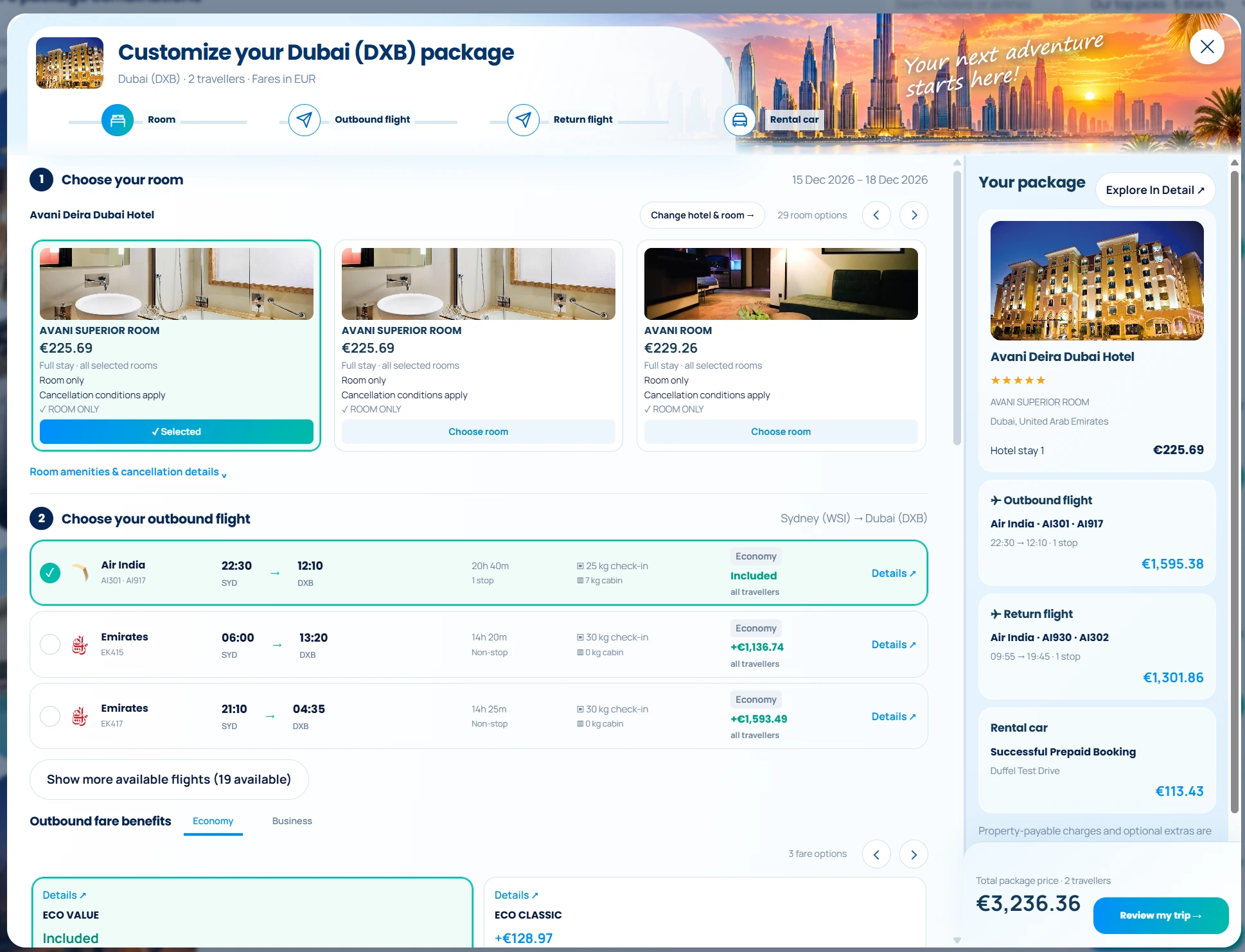
Start with flight and hotel packaging, then explore optional airport transfers, rental cars or activities. Define room occupancy, baggage presentation, pickup details and activity dates around the information your approved suppliers provide.
For airline dynamic packaging, plan how authorized flight content connects to accommodation and destination services. Existing flight reservation systems can be assessed as part of that approach.
Multi-city development needs destination-by-destination stays, transport segments and scheduling checks. Agree supported routes and combinations rather than assuming every product can be combined.
Explore the package-building experience
Tell us about your current systems, business priorities and project requirements.
Build Your Dynamic Packaging Platform ↗From Destination Search to Booking
- Destination
- Dates
- Travellers
- Flights
- Accommodation
- Optional Services
- Repricing
- Customer Review
- Booking
Select the Trip and Components
Capture departure point, destinations, travel dates, traveller ages and room requirements. Present eligible flights, accommodation and extras, with an itinerary summary that keeps selections tied to the correct travellers and dates.
Reprice Before Commitment
Recheck live inventory and selected rates before commitment. Offers can expire or change while a customer builds a package; repricing does not itself reserve availability. Obtain approval for changed prices or replacement options.
Review, Pay and Verify
Present inclusions, exclusions, conditions, the combined price and any amounts payable separately. Agree payment authorization and capture timing around the gateway and supplier workflows; delayed capture is available only where supported.
Retrieve supplier confirmations before marking required components complete. Keep payment, reservation and ticketing states distinct.
Tell us about your current systems, business priorities and project requirements.
Build Your Dynamic Packaging Platform ↗Pricing Controls With Commercial Visibility
Define component prices and the package selling price separately. Agree the cost basis for margin calculations, and distinguish markup from commission income.
| Pricing or operational area | Proposed control |
|---|---|
| Component costs | Retain supplier amounts, included taxes and separately payable extras. |
| Package price | Apply agreed fixed or percentage markups without duplicating charges. |
| Commissions | Track expected and received amounts separately from customer payments. |
| Currencies and fees | Record exchange rates, rounding, display currency and settlement amounts. |
| Promotions and margins | Recalculate after discounts; block sales below the configured selling-price floor. |
| Booking and finance | Keep confirmation, payment, refund and outstanding-balance statuses separate. |
Your project can include role-based pricing permissions and an audit trail for agent edits. Show the offered price against the calculated package total and minimum permitted selling price, with projected margin visible to authorized staff. Configure gross-profit reporting using agreed revenue and cost definitions, with commission treatment confirmed during discovery.
Identify taxes already included and charges due locally. Apply the selling-price floor after promotions, currency conversion and manual adjustments—not only when the original quotation is created.
Connected Suppliers, CRM and Back Office
- Customer / Agent Interface
- Package Engine
- Supplier Adapters
- Approved Suppliers
- Package Engine
- Payments · CRM · Back Office
The proposed package engine coordinates selections, pricing and booking progress. Supplier adapters translate flight, accommodation, car, transfer and activity requests while retaining each provider’s references, conditions and status responses. Each connection is scoped and tested individually.
Assess travel API integrations individually, confirming credentials, commercial permissions, supported operations and production approval requirements per project. Development does not grant distribution rights. Actions unavailable through an API need a defined manual process.
Connect agreed customer, quotation and booking records to your travel CRM and back-office systems. Define which system owns each record, how updates synchronize and who resolves discrepancies. Keep credentials server-side and agree access controls, protected logs and data retention.
Handle Exceptions Without Hiding Them
Partial Failures and Mixed Booking States
Track each supplier reservation independently within the combined checkout. Plan separate confirmed, pending, failed and cancelled states for each component, with coordinated recovery when only part of the package completes.
A timeout does not necessarily mean a booking failed. Verify the existing transaction before retrying a booking request, following the provider’s recovery process.
When flights confirm but a hotel fails, route the package to operations. Present alternatives or permitted cancellation options with customer approval; do not silently replace services or assume confirmed bookings can be reversed.
Changes, Cancellation and Documents
Record component conditions alongside your business-approved package policy. Include eligibility checks, revised prices, penalties and customer approval before submitting changes. A cancellation quotation is not the same as a completed cancellation.
Synchronize itinerary and voucher updates after verified supplier changes. Identify superseded documents, retain booking references and flag any update that still requires staff action.
Payment Reconciliation
Match gateway transactions and supplier charges to the package and component references. Track customer refunds separately from supplier reimbursements. A refund request may remain pending or fail, so its submission must not be displayed as completed reimbursement.
A Practical Implementation Approach
We begin with your selling model, supplier access, package combinations and servicing responsibilities. Discovery maps required fields, commercial rules and the first complete booking journey before expanding scope.
Testing should cover repricing, expired inventory, duplicate submissions, payment failures, partial confirmations, currency rounding, selling-price floors and document updates. Agree acceptance criteria, operational ownership and escalation routes. Launch the approved scope with monitoring and staff guidance; add further suppliers or multi-city features through controlled releases.
Built Around Your Selling Model
Agencies can plan consultant-led quotations; tour operators can define configurable itineraries. OTAs can develop self-service journeys through B2C travel platforms.
Destination management companies can explore combining contracted local services with approved API inventory. B2B distributors can define agent permissions and commercial rules through B2B travel agency platforms. Accommodation-led projects can connect packaging requirements with relevant hospitality technology services.
Dynamic Packaging FAQs
What is dynamic packaging software?
It assembles selected travel components into a priced itinerary and coordinates their booking records. Dynamic holiday packages allow configurable choices rather than only a fixed itinerary.
How does the packaging process work?
Travellers or agents enter trip requirements, select components and review refreshed prices. The agreed workflow then coordinates payment, supplier bookings, confirmations and any exceptions requiring attention.
Can we combine flights and hotels?
Flight and hotel packaging can be the initial project scope. Confirm supplier access, room occupancy, passenger requirements and booking conditions before deciding which combinations to offer.
How are markups and package prices managed?
Define component and package pricing rules, commissions, taxes, currencies and discounts during discovery. Configure margin visibility and selling-price floors around your approved commercial model.
Can customers add transfers and activities?
These can be included where suitable inventory and permissions exist. Requirements include pickup locations, passenger capacity, activity schedules, age restrictions and confirmation processes.
Can the platform connect multiple suppliers?
Multiple connections can be assessed individually. Each requires data mapping, access approval and testing; matching products must not erase differences in inclusions or conditions.
What happens when one supplier booking fails?
The proposed workflow preserves confirmed records, identifies unresolved components and escalates recovery. Alternatives, retries or cancellations follow verified booking states and agreed operational rules.
Can the same platform serve B2B and B2C customers?
Both channels can be scoped around shared package logic, with separate permissions, pricing visibility and checkout journeys. Agent credit, approvals and other extended functions require explicit agreement.
Build Your Dynamic Packaging Platform
Tell TravelTech365 which packages you sell, which suppliers you can access and how your team handles bookings today. Define a platform scope that connects customer choice, commercial control and practical fulfilment.
Tell us about your current systems, business priorities and project requirements.
Build Your Dynamic Packaging Platform ↗