
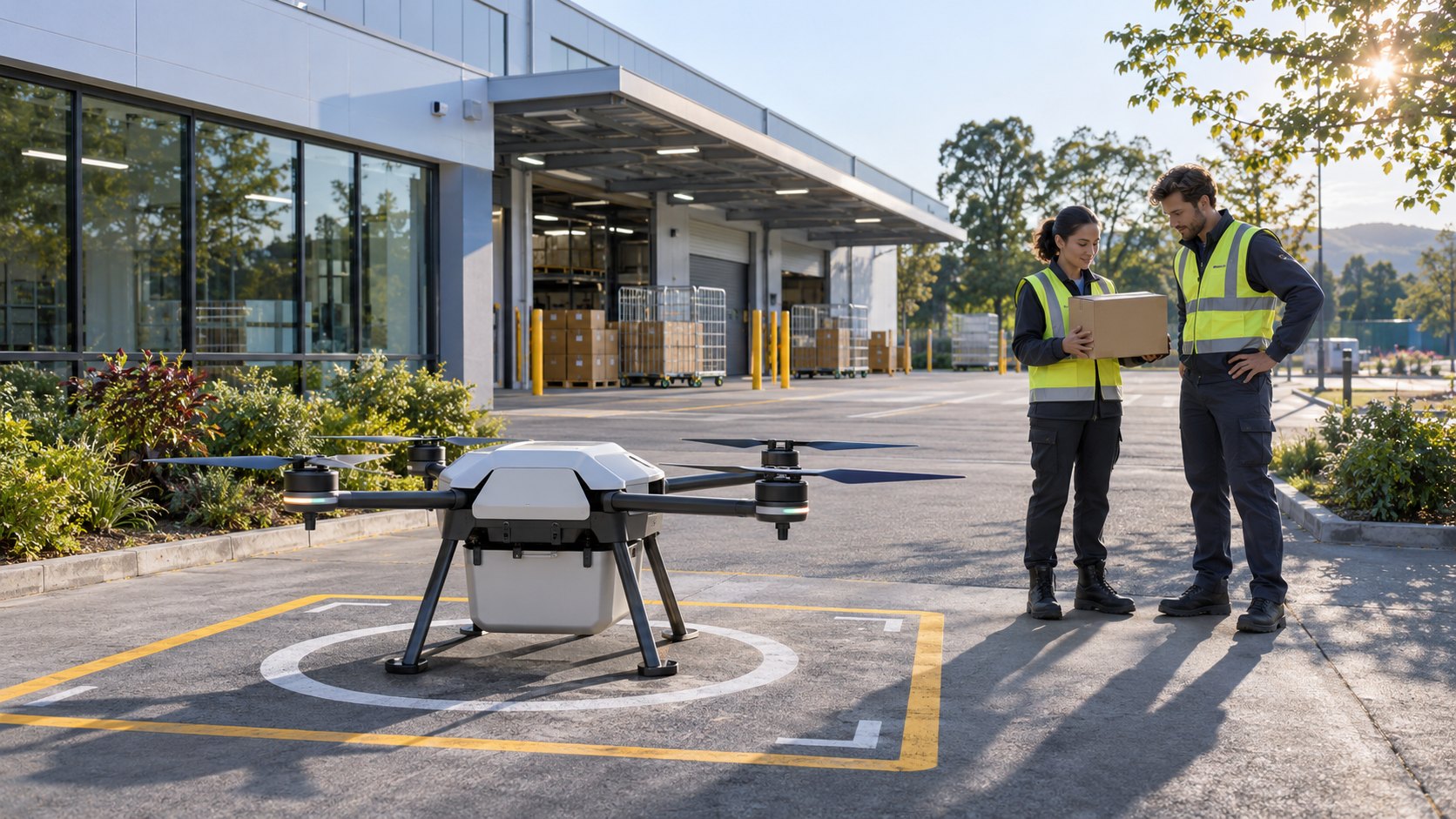
How Delivery Drones Could Deliver Packages and When Vans Take Over
A delivery drone may eventually bring a small online order to a designated spot near your home, but the experience begins much earlier than the moment a package arrives. A retailer must decide whether the parcel, address, delivery window and customer instructions qualify for the service. The retailer also needs a credible answer when they do not. Often, that answer is a conventional delivery van.
This guide explains how future delivery drones will deliver your packages from the retailer's point of view: the eligibility checks behind an offer, the boundary between an approved service area and an ordinary postcode, the customer handoff, and the operating measurements worth collecting before a retailer expands a pilot. It does not assume that every neighborhood or order can use a drone.
The goal is not to replace every vehicle. It is to offer another fulfillment choice while keeping the order, delivery promise and support history intact when methods change.
Start with a delivery promise, not a drone promise
Customers care about arrival times, prices and whether they must be present, not aircraft categories. The delivery page therefore needs to explain what the customer will experience, including any collection-point instructions, rather than foregrounding the equipment.
Drone delivery is one fulfillment option. A drone-capable partner may handle one part of that process; the retailer remains responsible for a clear shopping and support experience.
Why one order may need more than one delivery method
One basket could contain toothpaste, a small electronic accessory and a large bottle of detergent. The first two items might fit a participating drone service's documented parcel limits, while the bottle may not. Packaging can change the calculation: the operational weight and dimensions are those of the sealed parcel, not the unboxed merchandise.
The retailer needs an explicit policy for mixed baskets. It could offer to split an eligible item into a separate shipment, hold the entire order for ground delivery, or present both choices if the customer agrees to the resulting charges and timing. Silent splitting can produce confusing notifications, additional packaging and unexpected collection obligations.
The checkout promise should be deliberately conservative. “Drone delivery available for this order and address, subject to final dispatch confirmation” is more informative than a blanket claim of instant delivery. A retailer should only show a delivery window that its dispatch rules, local operating arrangements and fallback capacity can support.
Plan parcel eligibility before the customer pays
Eligibility is a sequence of business checks, not a single “drone-ready” product label. A small item can still be unsuitable because of its handling requirements, packaging shape, destination or requested time. Conversely, a product category that is normally excluded from a particular pilot should not become eligible simply because a cart weighs less than a threshold.
Build an eligibility record for each parcel
Start with a catalog-level indication of which items may be considered, then run an order-level assessment using the packed parcel. Store the item identifiers, declared contents, verified packaged weight, external dimensions, packaging type and any handling flags. The drone operator supplies its current acceptance rules, and the retailer translates them into a versioned decision that can be explained later.
For example, an operator may define limits on payload, parcel shape, compatible packaging, number of packages per service request or categories it will not accept. These are operator-defined constraints, not universal drone limits. Keep them in configuration rather than hard-coding assumptions into every product page, and require an owner to approve changes.
The order also needs ordinary fulfillment checks. Is the item physically in the participating store? Can it be picked before the service cut-off? Does it require identity verification or a handling process that the pilot cannot support? Is the customer eligible for the service under the retailer's published terms? An item passing the weight test can fail any of these checks.
Make the result auditable. A record such as “ineligible: package dimensions exceed current partner rule” is useful to a dispatcher and a customer-service agent. “Delivery unavailable” without a reason makes the pilot difficult to improve. Avoid exposing sensitive operational detail to shoppers; a plain explanation such as “This item requires standard delivery” is usually sufficient.
Check address, time and customer participation separately
Next assess the destination. A shipping address is not automatically a usable handoff location, and a postal code is too broad to prove coverage. The system needs to check the exact serviced address or designated pickup point against the partner's active service map and any customer-specific conditions.
Time matters independently. A covered address may have no eligible delivery slot when the store is busy or the operator has paused service. Checkout should request a current service decision, apply a short validity period to the quote and recheck before dispatch. A stale coverage result should never authorize an order by itself.
Participation should be deliberate. Before customers choose the option, describe where the parcel will be placed or collected, whether someone must be present, how notifications arrive and what happens if the location is unsuitable. Provide a standard ground option without pressuring customers to accept unfamiliar conditions.
A sensible rule engine returns more than yes or no. It can return eligible, eligible with conditions, temporarily unavailable, or not eligible, together with an expiry time and customer-facing reason. Those distinctions help product teams avoid advertising a service that dispatch cannot actually fulfill.
Use approved operating areas, not marketing radius circles
Mapping a circle around a fulfillment hub is a convenient planning illustration, but it is not an authorization. A retailer should treat its operator's validated service-area data as the source of truth. Coverage may depend on a particular hub, delivery destination type, schedule and conditions within the scope of the operator's approvals.
Store a service-area identifier and version with each eligibility decision. If the operator updates a boundary or temporarily withdraws a location, the retailer's checkout and dispatch tools need to reflect the change. A customer who previously received a drone shipment must not be assumed eligible for every future order.
United States regulatory example: approvals sit with the operator
United States example only: The Federal Aviation Administration describes package delivery operations using its Part 135 certification framework and associated authorizations, exemptions or waivers where applicable. Its Package Delivery by Drone guidance explains the operator certification pathway, airspace authorizations and the responsibilities of participating operators. This discussion is not a claim about rules in other countries.
The retailer's workflow should verify that a proposed service is covered by the operator's actual permissions and documented operating scope. A commercial partnership, a coverage map in a sales presentation or a successful demonstration does not independently establish approval for a new hub, address or service pattern. Legal and operational teams should confirm scope with the operator before a pilot goes live.
Location planning may also involve environmental review and community engagement. The FAA's Public Involvement and Environmental Review for Drone Operations discusses review under the National Environmental Policy Act, potential public input and local land-use considerations for hubs. These processes concern proposed operations; they should not be treated as a universal approval or a guarantee that a specific location will be accepted.
In practice, dispatch needs a simple outcome: “this parcel may be offered to this operator for this destination and slot,” or “use another method.” Aviation procedures belong in the operator's domain. Retail technology should preserve the approval-related service constraints it has been given and prevent orders from bypassing them.
Design the journey from checkout to customer handoff
The most useful way to design a drone option is to walk through the order as a customer would. A shopper sees an eligible delivery choice, confirms the handoff arrangement and receives an order number. Behind the scenes, the retailer reserves inventory and sends a service request containing only the information the approved operator needs.
At checkout, make conditions easy to understand
The delivery option should state its price, an achievable delivery window, the relevant collection or placement arrangement and any customer action. If a designated point is required, show a clear description and let the shopper confirm it. Not every property has a suitable handoff spot.
Customers in apartments, managed communities and workplaces may face different access conditions. A designated collection location might be possible for a particular pilot, but only if the operator accepts it and the property arrangements permit it. Where no supported handoff option exists, the correct customer experience is a ground-delivery offer.
Distinguish a reserved delivery slot from a request pending confirmation. If the method is later changed, the order history should explain the change and show the revised window and any fee adjustment under the retailer's stated policy.
At dispatch, exchange status rather than assumptions
The retailer picks and packs the parcel, scans a unique package identifier and checks final weight and dimensions. Before tendering the parcel, dispatch revalidates stock readiness, service coverage, the delivery slot, the operator's current acceptance status and the customer's selected handoff arrangement.
Use explicit status events such as requested, accepted, parcel ready, transferred to operator, out for delivery, delivered, exception and returned or reassigned. The exact event names can differ by integration, but each must have a timestamp, source system and clear meaning. A request accepted by software is not equivalent to a package delivered to a person.
The customer should receive timely, restrained communications: order confirmed, a meaningful dispatch update, an actionable arrival or collection notice and a completed-delivery confirmation. Messages must not imply that an unattended parcel is already in the customer's possession. The service should define what evidence supports delivery completion and how disputes are investigated.
After handoff, support agents need the same timeline the customer sees, plus restricted operational notes where appropriate. They should be able to identify who currently has custody of the parcel and which team owns the next action. The customer needs one coherent delivery story.
Know exactly when a van takes over
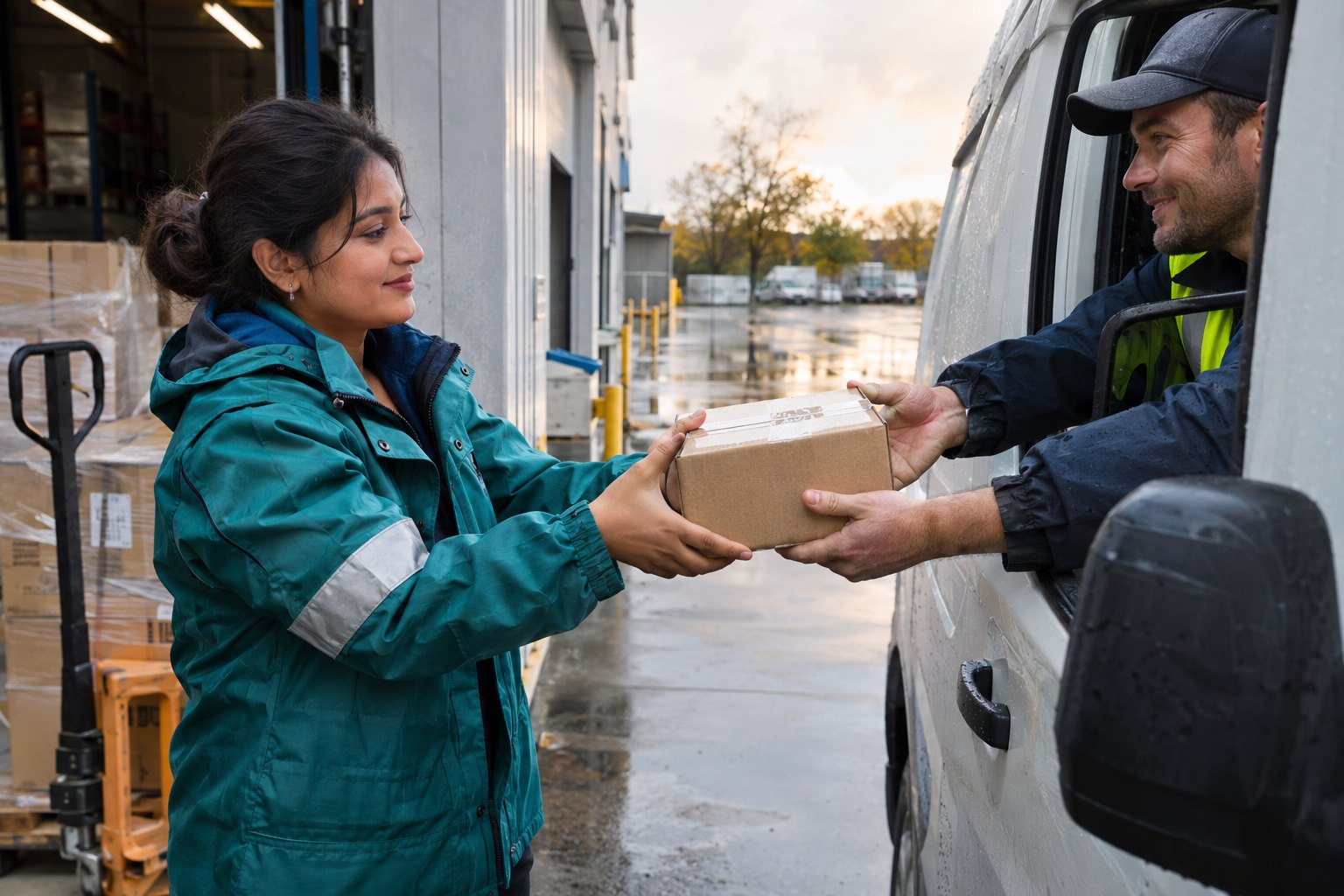
A useful pilot identifies exceptions early, protects the customer promise and makes the alternative visible. Vans or other established ground carriers are not an embarrassment in this model; they are part of the planned delivery network.
Set fallback triggers before the pilot starts
Define the conditions that prevent drone assignment: the parcel fails its final package check, an address is outside the active service map, the customer has not confirmed a required handoff arrangement, an operator declines the request, or no acceptable slot remains. Other cases may arise when the operator reports a pause or dispatch misses a cut-off.
Every trigger should map to an action, owner and customer message. Before the parcel is transferred to the operator, reassignment to ground transport is relatively straightforward: retain the same order and package identifier, cancel the drone request when appropriate and create a ground-carrier job. After custody changes, follow the agreed exception and return process rather than creating a duplicate shipment.
Ground fallback should be realistic, not cosmetic. The retailer needs available van or courier capacity, collection schedules, delivery-zone rules and a revised promise calculated from actual service options. “We will send a van instead” is not a useful policy if the next ground collection is two days away and the customer paid for an early arrival.
Decide in advance whether customers can opt out, whether delivery fees are adjusted, and how partial shipments are handled. If the alternative materially changes the arrangement, communicate it promptly and offer choices consistent with the retailer's terms. Support teams must be able to escalate a parcel that is in neither network's confirmed custody.
Track fallback reasons as structured data. A high proportion of package failures suggests catalog or packaging problems; frequent coverage rejections suggest misleading checkout eligibility; repeated missed cut-offs suggest store workflow issues. These patterns reveal whether to refine the pilot or remove the drone option from certain combinations of products and locations.
Illustrative worked example: one neighborhood retail pilot
Hypothetical scenario, not an actual operator or customer: A neighborhood retailer runs a four-week test from one participating store. It considers only small, nonrestricted parcels that fit a partner's documented acceptance rules. The partner supplies a verified list of addresses, supported handoff arrangements and available service windows. Standard van delivery remains an option at checkout.
A customer orders a phone charging cable and a notebook at 10:00 a.m. The retailer's catalog identifies both as candidates, but the packed parcel still needs verification. The exact address is on the active coverage list, a supported collection point has been confirmed and an eligible slot is available. Checkout displays a drone option alongside a ground option, with each method's own delivery terms.
The shopper chooses the drone option. At 10:08 a.m., staff pick the items and create one parcel. At 10:12 a.m., the parcel passes the retailer's final packaging checks; dispatch submits a service request. The operator accepts it, and the system records the acceptance event. Acceptance is not delivery.
Suppose the operator then reports that the selected slot is unavailable before accepting physical custody. The order-management system marks “drone reassignment required,” cancels or closes the original service request according to the integration agreement and checks available ground services. The earliest van delivery window now falls later that afternoon.
The customer receives a message explaining the method change, revised expected arrival and applicable delivery-charge treatment. The parcel keeps its order identifier, gains a ground-carrier tracking reference and moves into the existing dispatch queue. At completion, the retailer records the carrier's delivery confirmation and any customer inquiry against the original order.
A bulky home-cleaning refill, by contrast, never receives a drone option under the parcel rule. This is a successful eligibility decision, not a failed drone delivery. Counting that checkout as a “drone failure” would distort the pilot results.
For illustration, imagine the store receives 1,000 orders during the four weeks. Of these, 260 meet item and parcel screening; 180 also have eligible destinations and handoff conditions; 120 customers select the drone option; 100 are accepted for dispatch; 82 are completed by drone; and 18 accepted jobs require another outcome, including ground reassignment. These counts are invented solely to demonstrate measurement, not forecast performance.
The retailer should report the stages separately. Selection is 120 of 180 offered opportunities, or 66.7%. Drone completion is 82 of 100 accepted dispatches, or 82%. Neither percentage says whether delivery was more economical, whether customers preferred the experience or whether affected ground deliveries met their revised promises. Those require separate data.
Measure a limited pilot before discussing expansion
A pilot should answer a specific retail question: does offering the additional delivery method improve a defined customer or operational outcome for a clearly bounded order population? Name the participating store, study dates, SKU exclusions, destination set, permitted slots, partner rules and fallback process before collecting results. Otherwise, later changes make comparisons unreliable.
Use a funnel with consistent denominators
Separate all orders from candidates, eligible offers, customer selections, operator acceptances and completed drone deliveries. This prevents teams from reporting a high completion percentage while overlooking that almost no shoppers qualified. Record reason codes at every exclusion, including item restrictions, package checks, address conditions, slot availability, customer choice and operator rejection.
The scorecard below offers definitions, not targets. Set targets against the retailer's baseline before launch; small samples may support learning, not broad performance claims.
| Measure | Definition or denominator | Why it matters |
|---|---|---|
| Offer eligibility | Orders shown an eligible drone option ÷ all in-scope orders | Reveals actual customer reach |
| Selection rate | Customers choosing drone ÷ eligible offers | Tests demand and clarity of the offer |
| Acceptance rate | Operator-accepted requests ÷ submitted requests | Tests the quality of dispatch screening |
| Drone completion | Confirmed drone deliveries ÷ accepted dispatches | Shows how often the planned method completes |
| Fallback rate | Accepted dispatches reassigned to ground ÷ accepted dispatches | Measures exception burden |
| On-time result | Orders delivered in the customer-promised window ÷ delivered orders | Measures the experience across both methods |
| Cost per delivered order | Allocated end-to-end pilot cost ÷ delivered pilot orders | Tests business viability beyond transport fees |
Capture the customer experience, not only delivery events
Record the estimated window shown at checkout, any later revision, actual delivery confirmation, notice timestamps, contact-center interactions, refund adjustments and customer complaints. Separate a missed original promise from a delivery that arrived within a newly communicated window; otherwise reassignment can make poor reliability appear acceptable.
Ask customers concise questions about clarity, convenience and confidence in the delivery instructions. Keep feedback voluntary and link it to the relevant service stage without collecting unnecessary personal details. A rapid delivery that leaves the customer unsure where to collect the parcel may not be an improved experience.
Define dispute categories before launch: parcel reported missing, inaccessible collection point, incorrect status, notification received late, unexpected fee and confusing fallback. Review both counts and rates. Ten complaints across a small cohort may require more attention than a polished average satisfaction score suggests.
Compare costs and environmental outcomes carefully
For unit economics, include picking changes, dedicated packaging, partner service fees, integrations, additional support, refunds, failed delivery handling and any ground fallback. Separate one-time setup from recurring cost, and show the basis used to allocate shared expenses. An inexpensive single movement is not the same as an inexpensive completed customer order.
A fair ground comparison needs similar basket sizes, delivery distances, periods and customer requirements. Report the share of ground trips truly avoided, not merely the number of drones dispatched. If a van still visits the same address for another parcel, the marginal change may differ from a simplified one-package-versus-one-van story.
Apply the same care to environmental claims. Collect relevant energy, packaging and ground-movement information where credible data is available; identify missing information and specify the comparison boundary. Do not equate an electric aircraft with an automatically lower overall impact. A pilot can report measured activity while withholding unsupported emissions or noise conclusions.
Community feedback belongs in the review as well. Document how neighbors and property managers can raise concerns, who responds, and what changes result. Retailers should coordinate with their approved operator on its outreach and applicable local conditions rather than interpreting customer enthusiasm as community consent.
Connect the systems and make the expansion decision
A useful technical design links checkout, inventory, order management, dispatch, the operator, ground carriers and customer messaging. Each service should exchange an order identifier, parcel identifier, method, service window, status and exception reason where needed. Avoid maintaining separate, conflicting tracking stories for each carrier.
Keep eligibility and service-area rules versioned, with access limited to authorized staff. Log changes to parcel decisions and quotes, but retain personal information only as necessary for fulfillment, support and the retailer's applicable obligations. Technical teams should test duplicate events, late status messages, operator rejection, timeout and reassignment before accepting live customer orders.
Assign business ownership as clearly as technical ownership. Merchandising manages item candidates; fulfillment verifies packing and cut-offs; the delivery partner maintains its service constraints; customer support owns service recovery; finance reviews costs; and a designated pilot lead resolves conflicting decisions. A dashboard without people accountable for exceptions is not an operating model.
At the pilot's end, compare results with the baseline and the success criteria set before launch. Expand only if coverage is real, customer instructions are workable, handoffs are consistently documented, fallback remains dependable and the economics justify another service area. If the evidence is mixed, adjust a limited variable—such as parcel selection or checkout language—and retest rather than broadening every constraint at once.
That is the practical answer to how future delivery drones will deliver your packages: retailers will offer the option only when the order and destination qualify, confirm the arrangement at dispatch, document the handoff and move the parcel into ground delivery when conditions change. The future may involve more delivery choices, but a trustworthy promise will still depend on clear rules, honest updates and a reliable way to finish the order. Businesses evaluating connected retail and logistics workflows can explore TravelTech365 as a starting point for discussing their specific software requirements, without assuming any particular drone integration or operational approval.