
Fast delivery is useful only when the arrival promise is believable. A retail app that offers every shopper the same short countdown may win attention at checkout, then disappoint when a store is busy, a courier is unavailable, or the basket needs extra preparation. A stronger approach is to choose a service mode from the conditions that exist now, communicate a clear window, and give customers an alternative before an unrealistic promise becomes an order.
Start with a service decision, not a speed claim
Discussion of the scope of on demand delivery apps and market trends often begins with speed, geographic coverage, or the number of services in one application. For a retailer, the more actionable scope is narrower: which order can this location prepare, which fulfillment method can finish it, and which choices will the customer actually accept? Delivery promises are operational commitments, not decorative badges beside the basket total.
Define three distinct ways to fulfill an order
Immediate delivery means the customer orders now and receives a feasible near-term arrival interval, such as 55–75 minutes. It is not necessarily a fixed number of minutes from tapping a button. The store must be able to release the basket, and a courier must be able to collect and deliver it before the displayed upper bound. The app should suppress this option if either condition is uncertain beyond the retailer's tolerance.
Scheduled delivery lets the customer select a later supported window. The app can prepare inventory and reserve capacity for that period, but it should avoid offering unlimited slots merely because the calendar contains empty cells. A scheduled window still consumes picking labor, staging space, courier time, and the customer's attention. Each slot needs an explicit order cutoff and a rule for closing when commitments reach capacity.
Store pickup replaces the courier journey with a ready-for-collection promise. It can remain available when delivery capacity is exhausted, provided the chosen store has stock, staff, collection space, and a realistic preparation time. Pickup is not a universal fallback: long travel, accessibility needs, bulky goods, and inconvenient opening hours may make it unsuitable for some shoppers. Choice should be real rather than a forced substitution.
Set policy boundaries before checkout
Set policy boundaries first. These may include product restrictions, store closing times, delivery zones, courier shift limits, hazardous weather procedures, and maximum time that temperature-sensitive goods may wait. Separate hard exclusions, which cannot be overridden at checkout, from adjustable buffers, which may change after evidence is collected. A basket outside those boundaries should receive a truthful alternative, not an optimistic estimate.
Calculate readiness at the store before estimating arrival
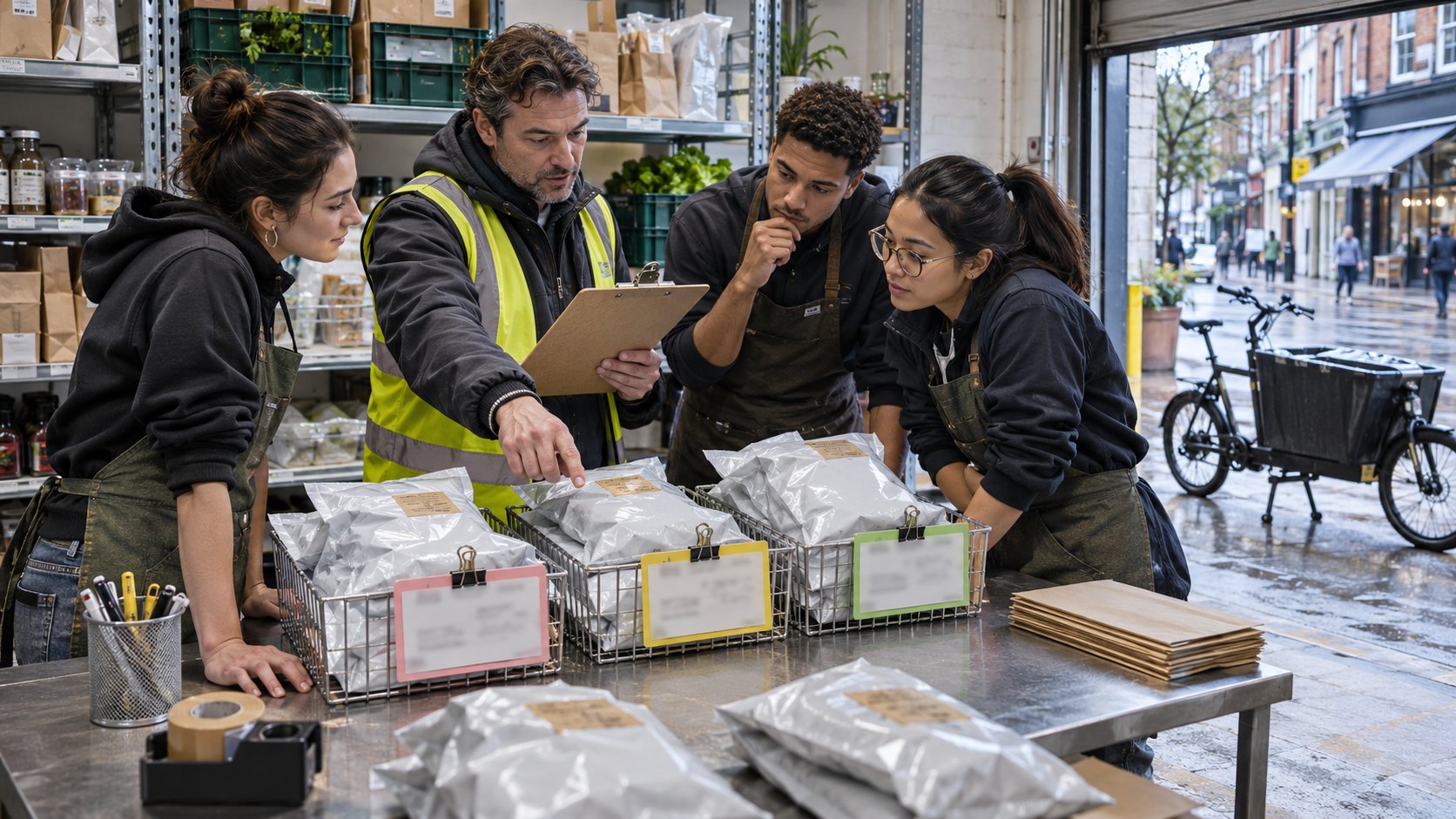
The store is the first clock in the promise. A courier's route calculation is of little value if the bag is still waiting to be picked, an item requires confirmation, or the order has not cleared payment checks. Build an earliest reliable handoff time using inventory confidence, the active preparation queue, picking and packing duration, and any required verification. Record both the estimate and the eventual handoff timestamp so errors become visible.
Model preparation as work, not a constant
For each candidate store, estimate when staff can start the basket, how long picking will take, and how much packing or quality checking remains. A small shelf-stable basket may differ materially from a large mixed grocery order. Store-specific observations are more useful than one universal preparation number. Consider staffing by shift, recent queue depth, basket size, product categories, substitutions, and observed preparation variability rather than basing the window entirely on straight-line averages.
Use a cautious readiness percentile or an evidence-based buffer rather than declaring that every basket will take the median time. A typical order prepared in 12 minutes may still need a 20-minute planning allowance during busy periods. The exact allowance should be calibrated from actual store records and reviewed when staffing or assortment changes. Keep a separate flag for stores with insufficient history; false precision is worse than a modestly wider customer promise.
Handle inventory and substitutions before the clock starts
An inventory count is not a guarantee that a specific unit can be picked. Recently sold stock, damaged goods, misplaced items, and catalog synchronization delays can all affect readiness. The checkout rules should distinguish confirmed available, likely available, and unresolved items. For uncertain baskets, the retailer can present a longer window, offer approved substitutions, ask the customer to choose a different store, or decline immediate delivery rather than promising a handoff it cannot support.
Turn courier capacity into a feasible delivery window
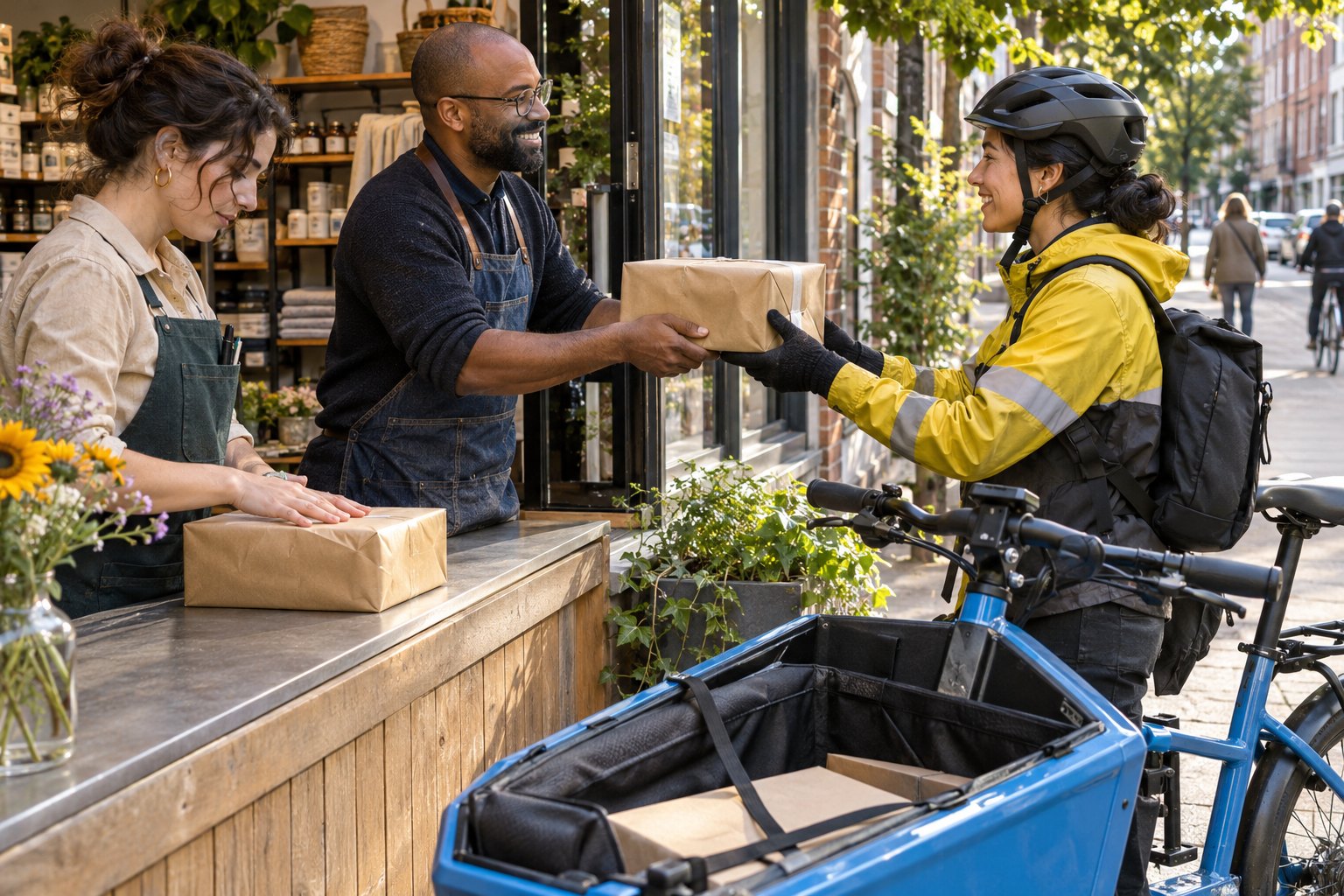
Once a handoff time is plausible, the next question is whether an available courier can reach the store, accept the order, and complete the drop-off within a responsible range. A dot on a map does not establish usable capacity. The courier may be completing another task, approaching a shift boundary, carrying a full load, or located across a slow crossing. Include actual assignments and service constraints instead of counting every online courier as immediately free.
Separate supply, reservations, and travel uncertainty
A practical capacity calculation considers couriers active in the zone, work already committed, expected release times, vehicle suitability, service duration at pickup and drop-off, and predicted travel time. Reserve capacity for each accepted promise so two shoppers cannot unknowingly claim the same scarce slot. At checkout, a brief quote hold can reduce races between shoppers; it should expire visibly and trigger recalculation if the shopper changes their address, basket, or preferred slot.
Travel estimates are inputs, not guarantees. Traffic, building access, waiting at a collection counter, parking, and difficult drop-off instructions create variability beyond road distance. The app should allow a calibrated buffer based on local observations and known conditions. When data are thin, widen the window or remove immediate delivery instead of manufacturing precision. It is better to offer a reliable 70–90 minute interval than repeatedly miss a 40-minute badge.
Use route constraints without confusing them with the customer promise
Route optimization is one component of the system. Google's Route Optimization API base-structure documentation describes a model of shipments, pickups or deliveries, and vehicles. That structure is useful for thinking about which work must be performed and which courier resources could perform it. A retailer still needs its own checks for inventory, preparation, checkout eligibility, notifications, and customer-service policy around that routing model.
The related documentation on route time windows distinguishes global planning bounds, pickup and delivery windows, and vehicle start and end windows. It also notes that a shipment time window constrains the start of a visit, not necessarily the completion of the service. That distinction matters: a mathematically feasible route-start time does not automatically prove that a shopper's order will be handed over before the promised latest arrival.
Translate routing output into a customer-facing arrival range only after adding preparation readiness, service durations, travel uncertainty, and business rules. Recheck feasibility when the customer submits the order, then commit the confirmed version to an order record. An optimization result should support the retailer's decision, not override customer consent or invent capacity that was never available. Keep the original promised window immutable for later performance reporting, even if the live ETA changes.
Present choices that help shoppers make a decision
The checkout should answer three questions quickly: when can I receive this, how much does it cost, and what will happen if plans change? Show immediate delivery, scheduled delivery, and pickup only when each is feasible for the current basket, address, store, and time. Put the expected window beside the applicable price and explain relevant limits before payment. Avoid implying every method is equally fast or available throughout the day.
Write promises in customer language
A label such as “Arrives today, 6:10–6:40 pm” is clearer than “ETA 32 min” when uncertainty is meaningful. For scheduled service, state the date and local time zone if there is any ambiguity. For pickup, use “Ready for pickup between 6:00 and 6:20 pm,” followed by collection hours. Show fees, minimum spend requirements, and relevant item exclusions without burying them behind information icons. Accessibility requires that time and state changes are announced in text, not by color alone.
Explain why a choice is missing in plain, non-alarming terms. “Immediate delivery is unavailable for this basket right now” is more useful than a disabled button with no context. If the customer can choose tomorrow's slot or collect from a nearby eligible store, present those options alongside their costs. Do not show a countdown that continues falling after the quote has expired. When the shopper returns from another screen, refresh the underlying feasibility before displaying the same promise again.
Respect customer preferences without promising impossible exceptions
Provide a concise order summary before confirmation: fulfillment method, store or destination, earliest and latest time, fees, substitution instructions, and contact preferences. Immediately after purchase, repeat the committed interval in the receipt and tracking page. Distinguish “order received,” “being prepared,” “ready for courier,” “out for delivery,” and “completed” using event-based statuses. A moving live ETA can be helpful, but it must not erase a missed original commitment from the record.
Build an explicit exit path when capacity falls
Capacity can disappear between search, checkout, and dispatch. A staff member may call in sick, several large baskets may arrive together, or a courier may end a shift. Treat these as normal operating states that the app can handle visibly. The safest response is to stop making promises that the system no longer expects to keep, while protecting orders already accepted and communicating any disruption with specific next actions.
Degrade the offer in a predictable order
Before payment, first re-evaluate whether immediate delivery meets its confidence threshold. If not, hide that option and offer a later scheduled slot supported by remaining capacity. If delivery slots are also full, show feasible store pickup with its own readiness window. If the store cannot prepare the basket or pickup is unsuitable, say the service is unavailable and allow the shopper to save the basket, change the store or address, or return when offers reopen.
Handle accepted orders separately from new quotes
An order accepted before capacity deteriorated has a distinct obligation. Monitor likely misses using actual preparation progress and courier status. If the promised upper bound is at risk, notify the customer before it passes where possible. Give an updated estimate, appropriate support access, and clear choices allowed by policy: retain the order, switch to pickup if genuinely feasible, reschedule with consent, or cancel with a transparent refund path.
Never silently replace an old promise with a newer one in analytics. Store the original interval, every proposed revision, the customer's decision, and the actual completion event. Keep a manual escalation route for exceptional orders, but measure how often staff must intervene. An exit path is functioning when it reduces avoidable disappointment, not when it simply hides failed commitments behind new timestamps. The customer should know whether a proposed alternative changes fees or item availability.
Design a limited pilot that can answer a real question
A pilot should test whether capacity-aware promises improve reliable fulfillment without unacceptable harm to checkout conversion, costs, or access to service. Begin with a small number of stores, defined delivery zones, stable product categories, and a fixed operating period. Include both ordinary and peak hours, but avoid starting during a major promotion or system migration that would make performance hard to interpret. Write down the decision rules before switching them on.
Define comparison groups and guardrails
Where feasible, randomly assign eligible checkout sessions to an existing experience or a new capacity-aware experience, while ensuring both groups share comparable stores, hours, inventory conditions, and courier pools. If simultaneous randomization would interfere with a shared capacity system, use a carefully matched phased rollout and acknowledge that its comparisons are weaker. Track assignment rather than only completed purchases, so an option hidden at checkout remains visible in the analysis.
Choose a primary metric such as the percentage of completed delivery orders arriving within the originally confirmed window. Guardrails should include order placement rate, cancellation rate, customer complaints, courier cost per completed delivery, store overtime, and the share of eligible shoppers who see any usable choice. Track immediate, scheduled, and pickup separately. Segment by store, daypart, basket complexity, distance, and customer accessibility needs when sample sizes permit, rather than trusting a single blended average.
Instrument each stage of the promise
Record eligibility evaluation, options displayed, quote issue and expiry, selection, checkout submission, order acceptance, store readiness, courier assignment, pickup, delivery, and cancellation. Include an anonymized experiment assignment, store and zone identifiers, the committed earliest and latest times, and a reason code when an option is withheld. Capture timestamps consistently, preserve local display time separately, and apply suitable access controls and retention limits to customer and location data.
Worked hypothetical example: calculate the pilot outcome
Consider an illustrative, fictional retailer testing a new checkout decision rule at two stores for two weeks. The original checkout displays immediate delivery broadly; the pilot evaluates store readiness and courier commitments before offering immediate, scheduled, or pickup choices. Each group contains 1,000 eligible checkout sessions, with comparable promotional conditions by design. The example is arithmetic for planning, not evidence of an actual retailer's performance or a predicted improvement.
| Metric | Existing checkout | Capacity-aware checkout |
|---|---|---|
| Orders placed | 600 | 650 |
| Orders cancelled after placement | 30 | 26 |
| Completed delivery orders | 500 | 500 |
| Completed pickup orders | 70 | 124 |
| Immediate deliveries completed | 330 | 290 |
| Scheduled deliveries completed | 170 | 210 |
| Deliveries within original window | 425 | 465 |
| Total courier spend for completed deliveries | $3,000 | $3,150 |
Calculate improvement using explicit denominators
The existing checkout places 600 orders from 1,000 eligible sessions, an order placement rate of 60%. The pilot places 650 from 1,000, or 65%, a five-percentage-point difference. Completed orders are 570 in the existing group and 624 in the pilot because cancellations remove 30 and 26 respectively. These figures suggest improved order uptake in the hypothetical sample, but say nothing by themselves about profitability or whether the experience works for every customer segment.
On-time delivery uses completed delivery orders, not all placed orders or pickup collections. The existing group delivers 425 of 500 within the original promise, or 85%; the pilot delivers 465 of 500, or 93%. The difference is eight percentage points. Late completed deliveries fall from 75 to 35 in equal-sized delivery cohorts. The relative late-rate decline is 40 divided by 75, or approximately 53.3%; it is not correct to call this a 53.3-percentage-point improvement.
Cancellation rates are 30 divided by 600, or 5%, and 26 divided by 650, or 4%. Courier spend per completed delivery increases from $3,000 divided by 500, or $6.00, to $3,150 divided by 500, or $6.30. The pilot therefore improves the illustrative promise result while increasing courier cost by $0.30 per completed delivery. A decision maker should weigh both effects rather than present the on-time figure alone as proof of success.
Interpret the result without hiding the mix shift
The groups complete the same number of deliveries, but the mix changes: immediate deliveries decline from 330 to 290, scheduled deliveries rise from 170 to 210, and completed pickup orders increase from 70 to 124. The overall on-time gain may partly reflect the easier scheduling profile, rather than a pure improvement in delivery execution. To test that possibility, calculate on-time performance separately for immediate and scheduled orders and compare like-for-like baskets and distances.
For illustration, suppose 264 of the existing group's 330 immediate deliveries and 161 of its 170 scheduled deliveries were on time, totaling 425. Suppose the pilot achieved 261 of 290 immediate and 204 of 210 scheduled deliveries, totaling 465. The within-mode rates would be 80% versus 90% for immediate, and approximately 94.7% versus 97.1% for scheduled. These additional assumptions support a more nuanced interpretation, but small slices still need uncertainty ranges and replication.
The pilot should not be declared a universal win from this sample alone. Inspect complaints, refunds, store workload, missing-option rates, and customer segments; establish whether the differences could plausibly arise from random variation; and confirm that the observed improvement persists at busy times. A sensible next action might be to expand to one more comparable zone with a predeclared cost ceiling, rather than remove every capacity limit or roll out the change to all locations immediately.
Track market changes as testable hypotheses
Market discussion is more useful when it becomes a measurement plan. The scope of on-demand retail services may change as shoppers adjust priorities, stores adopt different fulfillment practices, or local courier supply fluctuates. None of those possibilities needs a dramatic growth forecast. A team can state a hypothesis, define the signal that would support or reject it, and review the result by location and customer segment instead of treating broad industry language as proof.
Watch shifts in preference, supply, and economics
Hypothesis one: some customers will prefer dependable scheduled windows over the fastest available estimate. Test this through mode selection, repeat purchase, promised-window accuracy, and qualitative feedback when options are shown at comparable prices. Do not infer preference from selection alone if the immediate option was frequently hidden; track which choices were actually visible to each shopper.
Hypothesis two: store pickup may absorb demand during courier shortages without sharply reducing completed purchases. Compare eligible sessions, pickup selection, completed collection, no-show rates, and support contacts during matched low-capacity periods. A higher pickup share is not automatically good if travel burden is shifted to customers who had no practical alternative. Measure whether the fallback is genuinely usable, especially for shoppers with mobility or transport constraints.
Hypothesis three: growing basket complexity or more variable staffing may widen store preparation times. Monitor the distribution of ready-to-handoff duration by store, product mix, and shift. If preparation variability rises, test whether revised readiness buffers reduce misses without unnecessarily suppressing delivery offers. The intervention should respond to measured workload, not a general assumption that every store will become busier.
Hypothesis four: local courier availability and travel friction may change the cost of keeping narrow windows. Track committed courier minutes, idle time, failed assignments, distance, and spend per completed delivery alongside on-time outcomes. An increase in cost may be justified for a valuable service tier, or it may reveal that scheduled delivery deserves greater prominence. The answer depends on the retailer's own margins and customer behavior.
Make the promise system accountable after launch
Ownership should be shared across retail operations, dispatch, product, engineering, customer support, and analytics. A single service-level dashboard is helpful, but each team also needs a diagnostic view: store readiness error, courier assignment delay, delivery-time deviation, promise changes, and fallback acceptance. Agree on event definitions and review disputed cases together. Otherwise, teams can appear successful separately while shoppers experience a failed handoff between systems.
For TravelTech365 readers planning a retail delivery application, the practical design principle is straightforward: present only promises the operating network can currently support, preserve the customer's selected commitment, and measure both success and the cost of achieving it. Immediate delivery, scheduled delivery, and pickup should be coordinated alternatives rather than competing banners. A limited, well-instrumented pilot can show where wider windows, smarter eligibility checks, or better capacity allocation genuinely improve the customer experience.