

Ask every bidder to price the same release
An app development quote is useful when it connects a proposed payment to a result the buyer can inspect. A figure for six screens or one mobile application leaves room for fundamental disagreement. A customer may expect account recovery, a working notification and a production release. A supplier may have priced screen design, a login against test data and a binary handed to the client. The figures are hard to compare because their underlying commitments differ. Bring the same written scope, state diagrams and release conditions to each bidder before trying to compare their totals.
Begin with the person trying to finish one task. Identify the account they use, which record changes, and what success looks like from the outside. A small transit membership app might let a member view an existing membership card and request a replacement. A community organization may expect the card to be usable beside a scanner in an area with poor connectivity. That expectation can affect security, storage, support instructions and how the feature is accepted. Recording it at the start makes it harder for a shallow prototype to pass as a complete release.
Give the supplier enough context to turn the desired outcome into an engineering plan without telling them which implementation to use. Name the services you already operate, the mobile operating systems you want to support, and the people who can approve decisions. State which interface and production accounts your organization controls. If a partner's source system has never been tested, ask each bidder to show how they intend to verify it. Clear assumptions make differences in proposed architecture useful during evaluation.
The worked numbers below are private budgeting examples in fictional units. Price them against real scope and current proposals for your own purchase. The useful output is a reviewable cost structure, whose boundaries and evidence you understand well enough to discuss with another engineer or finance partner.
Write a short requirements pack that can support a decision
Describe journeys, records and exception cases
List the launch journeys as actions with start and finish criteria. Signing in is complete when a verified user can retrieve the correct record from an accepted source. Requesting a replacement is complete when an accountable queue holds the request and the member can retrieve its status. Reviewing a notification is complete when the intended device opens the right authorized record or shows a working return route. Ask each bidder to describe how they would demonstrate these outcomes starting from a fresh test account.
For each journey specify one ordinary failure. For the membership card, ask what happens if the record was just replaced while the phone is offline. For a replacement request, define what the app does if a network response disappears after the server accepted it. For a notification, test an expired account session or a person who has turned off optional messages. If the quote does not address these cases, ask whether the bidder assumed that they were outside scope or resolved through an existing service. Either answer can be checked in discovery.
Name the key data owners. The membership system controls entitlement, a delivery service might control the replacement's shipment status, and the app can present both. Define what staff can change from an operations screen, and which adjustments must remain within the existing system. Put a real owner beside each dependency. The quote can then identify which interfaces it expects and who needs to provide test data, sample responses, credentials or decisions. Restore access using the approved account route rather than asking people to email personal data to the project team.
Separate discovery from the build
A discovery proposal should name its artifacts. Explain how the developer will demonstrate any unproven dependency, document open questions and give you something useful at the end. For example, require a read and a sample replacement write against a partner sandbox, a decision record on whether a second login is necessary, and a draft acceptance matrix. Ask which assumptions survive even if the test succeeds. A proof of one test record may establish connectivity without verifying the entire product catalogue or commercial permission.
Ask bidders to price any work needed to change existing systems as its own line. A supplier may propose a small integration service, while another may expect your own engineers to build the needed events and revocation API. Neither proposal is automatically wrong. The buyer must know how much work is supplied by each party, and whether outside commitments can fit the schedule. When a supplier describes client-provided dependencies, ask for named artifacts with prerequisites and realistic approval points.
Document provisional assumptions using language a person can test. “Membership service has an API” is too vague. “The existing membership service owner will provide a supported endpoint that returns expiry, current credential identifier and revocation state for a test account” gives the team a result to verify. Pair each material assumption with an action if it proves false. The buyer can then choose whether to fund a connector, change the launch workflow, or reconsider the feature.
Separate the work packages and their acceptance evidence
What design buys and how to approve it
Design may cover research, prototyping, copy, accessibility and a documented component system. State how many workflows are demonstrated, whether difficult states are included and how feedback is collected. A prototype of the happy path often hides the expensive behavior. A membership status with no active plan, an expired credential and a queued replacement require different explanations. Make sure the estimate identifies which states the prototype needs to show, along with how unresolved policy choices become visible during review.
Ask whether the design contract covers screen-reader behavior, text scaling and localized copy where relevant. If the launch serves one audience and locale, specify that rather than assuming one prototype must support every language. Document fonts or images whose licensing needs a decision. Ask who retains editable design files and when those files are delivered. By the end of design the buyer should be able to make a backed decision about the build scope, and another team should be able to review the approved result.
What implementation, test and launch buy
Implementation should identify mobile surfaces, backend changes and operational tooling, even if the same team builds all three. For a rewrite, include data migration only if it actually needs to happen. An existing membership backend may remain authoritative while older clients continue to operate. Explain how the new release will work beside those clients and what migration is needed inside the phone. Ask how test fixtures and integration environments stay available across short project interruptions.
Testing proposals should specify the supported device set, the critical workflows and the owners who accept evidence. An estimate may include automated tests for state transitions and a short manual test on physical devices. Ask what happens after a defect is found during acceptance, how it is classified, and who decides whether it prevents release. Agree on a way to demonstrate that a failed request is safely recovered, instead of depending on a launch video that only shows the successful path.
The quote should specify transport to a test or store submission channel, not just declare delivery at code completion. Confirm ownership of developer accounts, signing keys, domain links and release environments. Review applicable store policies using the official Apple App Review Guidelines and Google Play User Data policy. Each bidder should explain who completes disclosure entries, prepares test access and responds to review questions. Neither provider documentation nor a contractor can promise a third party's approval date.
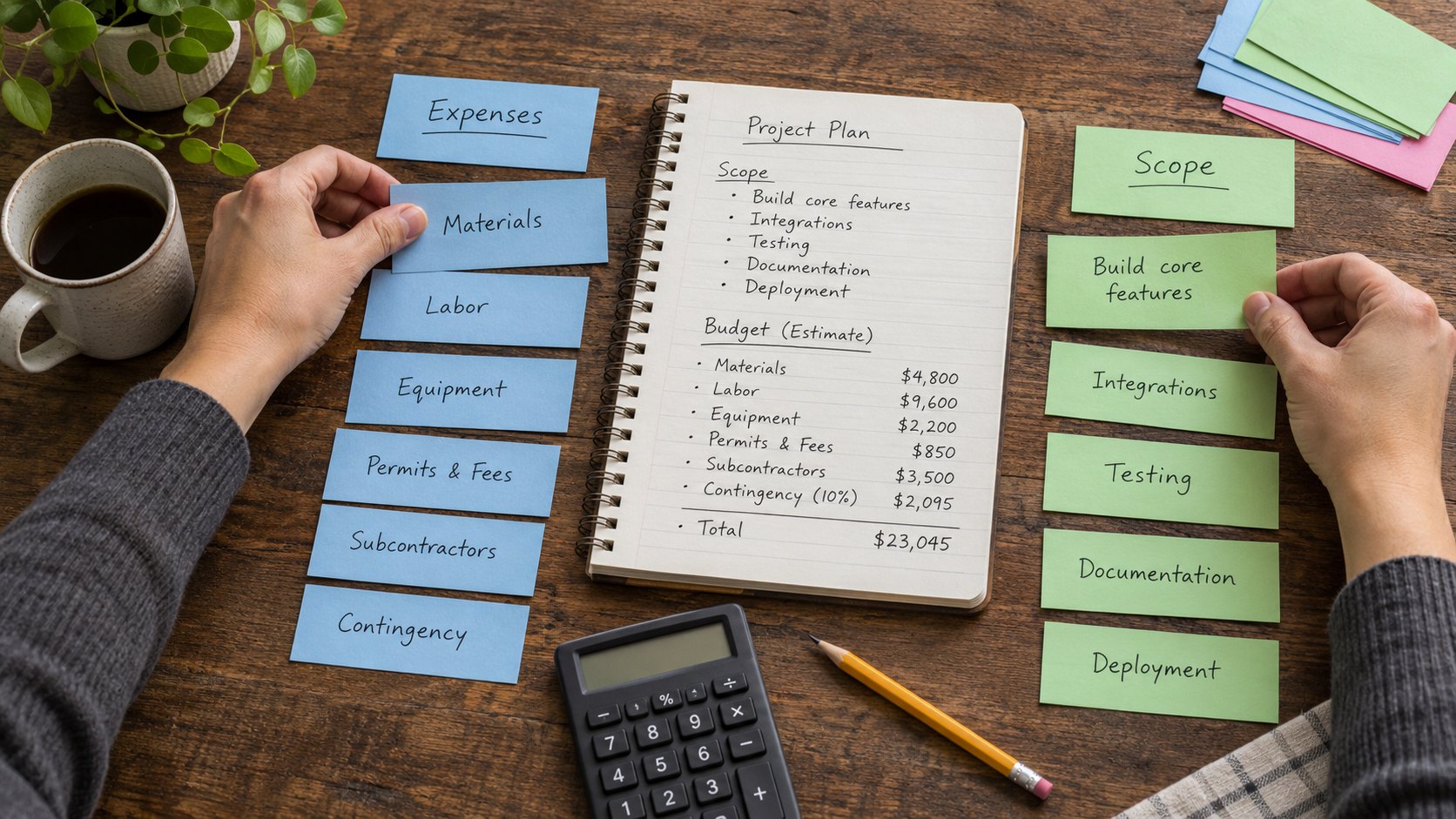
Compare two fictional proposals on the same first-year scope
Imagine a small organization called Meadow Pass that needs a member card with a single replacement flow. Bid A proposes 6,000 units for discovery, 9,000 for design, 40,000 for build, 8,000 for testing and release, and 1,000 per month for support. Bid B proposes 7,000 for discovery, 8,000 for design, 42,000 for build, 6,000 for testing and release, and 800 per month for support. Neither document includes the organization's own software subscription or partner fees. These invented numbers show how a first-year view depends on reading each bidder's assumptions.
Bid A includes a short validation exercise on the membership system but excludes changes to the service if validation fails. Bid B includes the existing partner connector under named interface assumptions and leaves the store submission to Meadow Pass. Each team offers defect support under scoped terms. When you compare, ask whether all quoted work can be accepted against the same written checklist and what the organization must pay or staff for in addition. An apparently more comprehensive estimate may delegate a costly phase to the buyer.
| Item | Bid A | Bid B |
|---|---|---|
| Discovery and design | 15,000 | 15,000 |
| Build | 40,000 | 42,000 |
| Testing and release services | 8,000 | 6,000 |
| Twelve months of scoped support | 12,000 | 9,600 |
| Supplier subtotal | 75,000 | 72,600 |
| Illustrative internal release work | 0 | 3,000 |
| Comparable first-year planning total | 75,000 | 75,600 |
Use arithmetic that reflects the actual commitment
In the fixture the numbers assume twelve full months of support within the comparison period, with no overlap between internal release work and the supplier charge. A real calendar-year budget can differ when support begins after release, an agreement bills quarterly or a launch slips. Identify the comparison horizon and ask how each contract defines its start date and any minimum term. Include platform fees, integration subscriptions and volume-dependent services in a distinct block so that the buyer can change traffic assumptions without rewriting the base quote.
Add contingency as the buyer's budget provision, not a supplier's implied mandatory invoice. For Meadow Pass a reserve of 5,000 units could cover a known risk with the replacement API, but will only become a commitment through the agreed change process. Record which risk the reserve is for, what would trigger spending it and who approves the use. If a bidder includes risk coverage inside a price, make them identify its trigger and limit so an internal model does not count that exposure twice.
Request examples of comparable evidence and repository handoff. An anonymized test report, a working integration test against synthetic data, or a reference architecture can demonstrate how a team closes risks. A named project story needs permission from the owner. A screenshot may show that a team designed a workflow without proving the server reconciled it. Ask bidders to walk through one approved published example and describe their own contribution. The output can help evaluate quality without making the supplier reveal trade secrets or personal data.
Agree how new information changes scope and cost
Write change requests against the baseline
A good change process starts from the dated scope and the assumption that changed. It records proposed work, choices, effects on timeline, security or acceptance and the cost treatment. Suppose discovery shows the membership service has no supported replacement write. The team could launch a tracked request sent to human support, build a partner integration when the interface becomes available, or defer replacement from the first release. The buyer needs to see which original outcomes survive each choice and what acceptance evidence will prove the revised outcome.
A late request to add custom appearance for two subsidiaries can touch signing, account segregation, content, operating support and legal review. The impacted release objects depend on whether the subsidiaries share an application or launch independent versions. Ask the supplier to distinguish expected technical work from approvals someone else owns. Retain the accepted wording with the date, approving role and any deferred tasks. Finance should be able to explain the change against the baseline invoice.
Document what counts as a defect against a previously agreed outcome. A card that opens but shows an expired record as active may be a defect when the scope states the expiry rule. Adding a brand-new card type is a potential variation. Evidence matters when the visual design, requirements notes and staged behavior drift out of alignment. Assign an order of authority for agreed records and confirm which decision must be updated before the team starts the expanded work.
Protect support and ownership after handoff
Define the maintenance service by coverage and response process. The person who sees a production problem needs a reporting route, named hours and a way to escalate critical cases. Ask whether the quoted support covers operating system updates, dependency updates, fixes, telemetry reviews, or a budget of engineering hours. Describe which causes fall to the buyer, a partner or the app supplier. Pricing is hard to compare when one support offer handles incidents and another only covers test-environment advice.
Publish artifacts to accounts your organization can access when a supplier relationship ends. At minimum agree on source-code access, authorized build instructions, dependency names and versions, supported environments, release procedure and documentation for key account owners. Confirm who can rotate keys through approved systems. Keep sensitive key values outside the documentation. A useful handover rehearsal starts from an approved build account and produces the expected test build without relying on someone's laptop or private repository.
Ask the bidder what happens to your data and access when support ends. Request a documented transfer, the timetable for access removal and evidence that important records remain usable. A contract may assign intellectual property rights while leaving an external account in the wrong name. Both procurement and engineering need to review the consequences before release. Retain completed acceptance and maintenance records next to the client-owned account list so the next team can trace what it received.
Run a signed-acceptance example before launch
Write one story in the test pack with an observable identity, trigger and outcome. Start with a synthetic member whose card was valid yesterday but was replaced this morning. Set the test device to the previous app build and turn off its network access. Open the membership area. The tester should see the agreed treatment of a previously cached card. The sample record may have been downloaded legitimately, but the organization cannot assume it is current. Before deciding that an outcome is an acceptance failure, the test reviewer needs to know the maximum offline age and wording agreed in scope.
Reconnect the app and fetch authoritative status. The tester should observe the new credential and the previous credential's changed state as specified. Then submit a replacement request and deliberately interrupt only the response after the system accepted it. Reopening the app should show the recorded request with its reference rather than create another case. A support reviewer should be able to trace the original and subsequent attempts without reading personal content from a log. Save test evidence and the relevant service state under an approved record retention policy.
If one supplier proposes to test this story and another proposes verification against a series of mocks, ask where actual device behavior and third-party limits enter the comparison. Synthetic service data can help reproduce a network interruption systematically. A partner sandbox can demonstrate how an integration behaves at its boundaries. Specify when each type of evidence is acceptable so the quote can allocate effort accordingly. A late disagreement on acceptance environments is harder to resolve if implementation already relies on unsupported behavior.
Set a written exit condition for each milestone. Discovery can finish when named dependencies are proven or a decision exists for every unresolved assumption. Design can finish when key users and failure paths are approved. Implementation can finish when its candidate build and configuration are available for acceptance. A planned launch can finish when review materials have been delivered and operations can own the support route. Record who signs and what they receive for each step. This gives finance a sensible way to match invoice release to tangible evidence under the agreement.
Ask someone from the proposed support team to take one role during the rehearsal. Their ability to find a request or recognize an unresolved status can depend on details not obvious to a developer. If operations must contact the original engineer for every incident, the handover is incomplete even when the member view behaves correctly. A bidder should say which tools and instructions support receives and who will help after launch. Budget any operational build or training separately if the supplier's quote does not include it.
Finally, use future platform work to validate the boundary of the first quote. Ask what would change when the app adds a second membership plan, deliverable language, or regional partner. The answer should distinguish planned extension points from fully prepaid feature work. Make sure your team can review the quote later without interpreting optimistic proposal copy as approval for an unpriced release.
Use the quote review meeting to settle acceptance
Invite the person who owns the launch outcome, a technical reviewer and the person who controls the budget. Ask each bidder to work through the same membership replacement fixture. Have them distinguish a pending request from an accepted operational case and show where the evidence would be found. Then ask how they would price resolution if the current connector cannot support the fixture. Record the bidder's answer in the same wording the team plans to use in the contract. Assign a person to check that the signed scope includes that decision.
Set a small list of proof points for the first milestone. You may need to see a test account retrieving the right membership, an agreed failure behavior, clear assignment of the release accounts and a budget that reconciles its line items. A demo should show enough information to decide whether to continue at the next stage. Schedule customer feedback so it can alter design before decisions become expensive to reverse. Let acceptance place the emphasis on outcomes a buyer will actually observe.
Finish the selection with a baseline that can survive a change in personnel. Record the required launch journeys, accepted proposal, dependencies, support routes and supplier assumptions in a shareable decision pack. Preserve differences between required outcomes and nice-to-have requests. If an estimate stays uncertain after discovery, ask which untested part controls the uncertainty and whether a narrower pilot can supply better evidence. This keeps the purchasing conversation focused on the final result and what the organization is prepared to own.
Carry the decision pack into the first month after release. Compare delivered outcomes with the acceptance list and actual support work with the forecast. If launch uncovered a dependency users care about, update the operating notes and record its effect on future budgets. A development quote often teaches the organization what to ask during its next procurement. Keep the evidence and contract boundaries accessible to the people who will maintain the app.