

Define what a recovered travel service can actually do
Cloud and AWS recovery planning starts with the work a travel team has to resume after disruption. A site can display search results while staff still lack reliable booking history or payment information. Travelers can see a login screen even though support cannot find a reservation made shortly before the outage. Specify recovery outcomes around real tasks. A support colleague should be able to find a booking, tell whether a traveler has received confirmation and identify payment evidence. A finance colleague should be able to find the same booking reference and tell which related transactions still need reconciliation.
Choose a service scope that can be tested in one rehearsal. For a small travel platform, begin with the booking ledger and read-only retrieval for staff. A later exercise can cover re-enabling paid bookings and supplier changes. Each launch stage needs a clear owner and a test of what the stage claims. A restored customer-facing page confirms availability of a process. A support agent who can find a booking and explain its state confirms availability of a business capability. Record these events separately so a rehearsal can reveal gaps and show improvements after concrete corrections.
Identify the authoritative system for each fact. The application database may own booking request data and customer-facing status. The supplier reservation record may own confirmation, changes or ticketing evidence. The payment service may have completed an authorisation or capture while the application was unavailable. Model the evidence relationships before a test starts. Write down which records staff can obtain without changing a customer's booking or creating another transaction. Where access depends on the supplier or commercial agreement, give that dependency a named owner and confirm it during a controlled rehearsal.
Set recovery objectives with the teams that face the outage
A recovery time objective is the target for restoring a capability within an acceptable period. A recovery point objective expresses tolerated data loss in time terms. Give each capability its own targets where they differ. Staff may need read-only booking history earlier than automated modifications. A finance team may accept delay in exporting a report while expecting a nearer recovery point for the ledger that feeds it. Time targets should trace to the practical consequences of people waiting or records going missing, so the team can judge the cost of improving the recovery design.
The AWS Well-Architected Framework covers planning for disaster recovery as part of its reliability guidance. Use those planning concepts to document what the selected architecture can recover and what it depends on. A backup and restore design can suit a particular set of recovery objectives. Other capabilities may warrant a shorter recovery path. Each design choice should have a testable consequence such as the time to initialise a database or the ability to retrieve external booking records while the restored traffic remains limited.
Agree the boundaries of the recovery clock. A drill can record the disruption time, the time the relevant signal is first visible and the time the team decides to invoke a restore. Start and end points should be stated beside every reported duration. If a backup restores fifteen minutes after an engineer begins the procedure, that figure answers a narrower question than elapsed time from disruption to a usable support search. Keep both measures because one identifies service impact while the other pinpoints where to improve the runbook or recovery mechanism.
Build an inventory that follows a booking end to end
Start with one representative transaction and list what it needs from request through receipt. Include the web request path, application configuration, authoritative records, notification delivery and the operational interface. Look for dependencies that are easy to assume, such as the data needed to translate an internal supplier identifier into the reference staff will actually search. Ask which already comes back through infrastructure deployment and which needs to be restored from authorised backups. Keep the inventory small enough to compare against the actual systems used in an exercise, then expand it when the next workflow is covered.
Write down where queues, schedules and messages fit. A recovered job processor can pick up old work or duplicate actions if it is enabled before staff establish the state of reservations and payment events. Identify which services open in read-only mode, which jobs stay suspended and how someone with the appropriate access enables one process at a time. Use test bookings and test notification destinations during rehearsals. Visible separation of test and production traffic lets team members verify how a booking email would progress without sending an unintended message to a traveler in the middle of the exercise.
Plan for configuration that has a lifetime outside the restored dataset. An application can launch while a callback still points to the original environment or a mapping configuration was changed after the selected snapshot. Record the ordinary process for attaching the intended environment configuration to the restored resources. Keep private values in approved stores and out of the rehearsal notes. Capture an environment identifier and the configuration version instead. Test connection paths that are necessary for the exercise and mark which ones depend on external environments that can only be validated later.
Build an evidence list before an incident
For a booking record, keep a map of correlation fields and their scope. A travel business could use an internal booking request number, a supplier record locator and a payment reference. They can remain related while continuing to serve distinct purposes. Document which of these systems can be queried with each identifier and who can do so. After a restore, the map helps staff locate relevant evidence even if the local record has not recovered. It also lets engineers design a staged set of comparisons before accepting new modifications.
Set up representative synthetic records in the test account. Include a confirmed reservation, one that awaits a supplier response and one with a payment authorisation that has yet to reach the local ledger. Give the tester expected states that can be checked against a fixture or a carefully controlled external test application. A complete exercise should tell the difference between a record missing from storage and a record that was legitimately never committed. Visible expectations let the team check the first hours after recovery as well as the simpler bookings that were settled days before an incident.
Include a test that validates staff can recognise incomplete evidence. Give an operator a booking reference that appears only in the payment fixture while the supplier record is still uncertain. The intended action may be to preserve the reference and escalate rather than treating the reservation as confirmed or resubmitting it. Measure how long the decision takes and which missing view slowed it down. This exercise highlights a problem that can survive all infrastructure checks. It is particularly useful when multiple partner systems expose details through different authorised portals or reporting tools.
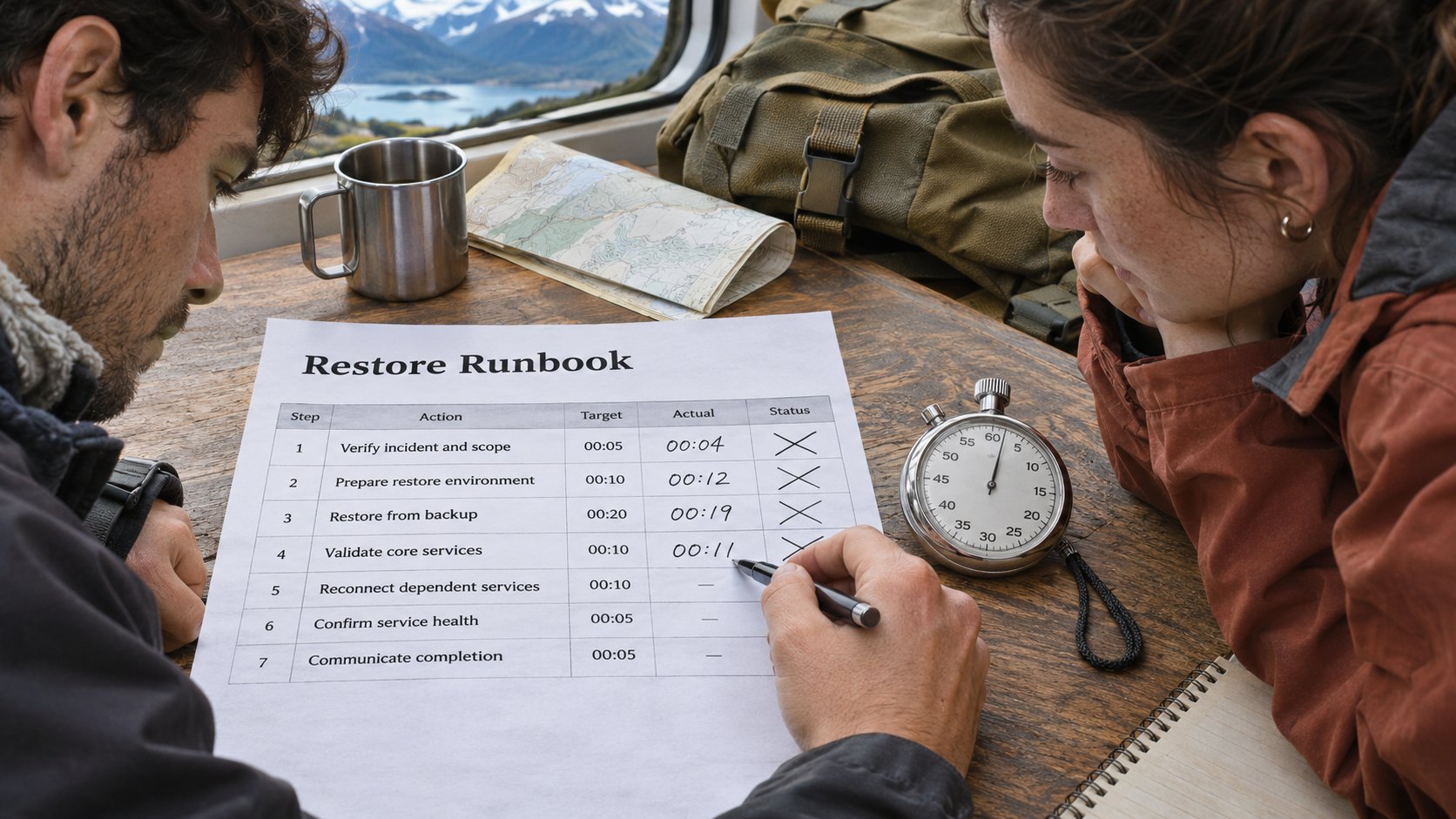
Measure a restore timeline with a concrete booking example
Consider a fictional outage at 10:30 during a weekday booking period. The team selects a restore point from 10:24 and marks both times in the log. Three reservation events land after the restore point. A confirmed booking from 10:26 may exist at the supplier. A payment authorisation from 10:27 may still be visible separately. A traveler may have started booking at 10:29 without completing the workflow. Each case needs a bounded check tied to the original event, with care to avoid action based only on a restarted application status.
At 10:36 the on-call engineer invokes the procedure. At 10:51 the selected database opens in the restored environment. At 11:04 support staff can retrieve a confirmed 10:20 test booking through a read-only interface and see the relevant reference. At 11:18 the team completes disputed-window checks against synthetic supplier and payment records. In this example, restoring the database took fifteen minutes from invocation. Staff could access a validated read-only record thirty-four minutes after disruption. Record both dates and durations with the version and environment so observers can compare the next run fairly.
The restore point at 10:24 provides a six-minute elapsed gap from the fictional incident for that snapshot. The six minutes describe a dataset boundary. They do not reveal every transaction that needs action because partner events may have their own observation periods and ledger timing. Inspect the restored records and independent evidence for the disputed window. When the difference can be reconciled, record how each entry is matched and which approved compensation or manual decision is appropriate. Any unresolved entry should remain visible to operations in the recovered workflow.
Record why each stage is complete
| Time | Milestone | Evidence retained |
|---|---|---|
| 10:24 | Selected restore point | Recovery record identifier and restore policy |
| 10:30 | Fictional service interruption | Drill event and clock source |
| 10:36 | Procedure invoked | Recorded status and recovery environment |
| 10:51 | Database available for checks | Resource ready event and controlled connection result |
| 11:04 | Support booking retrieval works | Read-only test case and duration since interruption |
| 11:18 | Disputed window reviewed | Synthetic booking, supplier and payment comparisons |
Use the same milestones regardless of whether the architecture is improving or someone is reproducing a failure. A timed run that omits recovery validation is hard to compare with a later run where staff checked actual cases. Add relevant constraints, such as a fresh account role, a prepared isolated environment or a known slow dependency. Describe which steps were prepared before the simulated outage and which were part of reported elapsed time. This stops a rehearsal from recommending a change based on an apparent gain that came from moving preparation outside the measured window.
Run restore tests with nonproduction evidence
AWS Backup documents restore testing for supported resources. Review resource coverage and the conditions for the types used by the travel application. A successful managed restore test can provide coverage for the restore activity and help surface configuration issues. Pair it with controlled application verification. Test that the correct application build can use the recovered resource, normal read paths work for intended roles and record relationships are still usable. Use sanctioned restore targets with an explicit scope and cleanup process.
Isolate the exercise from live supplier operations and outbound effects. Give the restored application its own legitimate test environment, networking and fixture-only integrations. If real data is needed for a governed internal exercise, restrict access and choose checks that avoid unnecessary copies or exposure. Agree who can enter the test and which observations can safely be retained. Capture business outcomes using case IDs and statuses, avoiding contact details in the run notes. Cleanup should account for restored resources, attached data and any optional screenshots or diagnostic exports created during the test.
Use test inputs where a reviewer can say what a passing result means without opening production data. A pending booking should be retrievable with the same synthetic reference visible in a payment fixture, for example. A cancelled booking should remain cancelled after the restore path is exercised, and a staff change should appear only when it was committed before the selected recovery point. Where independently running services use their own clocks, record clock assumptions in the expected result. Keep the source fixture and comparison output so several teams can review the evidence after the scheduled time window.
Test the permissions and steps that a real operator will use
Run the exercise with both the engineering role that invokes the restore and the support role that needs the restored application. The engineer can check system health while support verifies normal permissions, expected cases and visibility of evidence. Capture the check that proves authorisations have been applied correctly to the recovered app. If a run depends on temporary privileges, use the incident procedure for requesting and expiring them. A team needs to know how long it will take to obtain the right access at the time of a genuine outage.
Ask a second person to take over part of the rehearsal. They should be able to understand which restore point the first operator selected, what state the recovery is in and which checks are still pending. Use existing incident communication procedures and place short updates at meaningful milestones. Record human dependencies such as waiting for a supplier account owner to validate the state of a cancellation. Those times belong in the rehearsal report even when an infrastructure metric can only measure part of the delay.
Reopen capabilities under a clear release decision
After restoration, decide when to expose a capability to more users. A deliberate progression may start with read-only service desk access, move to limited customer views and later reopen bookings. Use checks tied to each stage, so a later problem has a known place to halt or revert while work already recovered stays useful. For live writes, identify how the system will behave if it receives new bookings as the last disputed cases are resolved. Verify that operators can see the age and state of unresolved work before enabling unrelated queues.
Define which checks the release owner sees. Useful evidence can include verified retrieval of recent and historical records, a review of pending partner events, separate examination of test payment activity, and successful results for notification restrictions. If one area fails, report the exact customer or operational effect. Another part of the site may remain safe to run, or two upstream processes may need to stay paused while staff investigate. Keep a prioritized list of the issues that would prevent the next stage so the decision can be made directly from evidence.
Reconcile follow-up work using stable identifiers and explicitly documented actions. For example, if a payment record was restored from an independent fixture and the supplier still has no associated confirmation, the operator needs a defined next decision. A documented workflow might gather more evidence, open a case or follow agreed refund handling. Select the action according to the travel business's policies and the supplier agreement. Record the exact outcome so later arrivals cannot cause the problem to be retried silently when the normal event feed resumes.
Turn a rehearsal gap into a change the next rehearsal can prove
Record where elapsed time or recovered state fell short of objectives and attach the smallest relevant evidence. The support search may succeed while lacking a supplier reference for a handful of recent bookings. In that case, assign a change to expose the reference in a controlled operational path, and build a fixture that demonstrates the gap. A future run can compare the same steps and report whether a support colleague can reach a sound decision faster. Carry forward the test until the recovered workflow is part of the normal release and restore checks.
Schedule a revised run after changes that add a datastore, alter booking state or move a payment integration. Keep the evidence close to the deployed architecture and review any dependency that requires a human or a partner to act. The most valuable rehearsal answers a traveler-facing question with recovered evidence, records the time to do so and identifies remaining uncertainty. That gives leaders a way to improve the recovery plan over time without assuming a restored service and a restored booking operation are proven by the same check.
When selecting the next exercise, give one owner a clear outcome. For instance, the finance team should be able to identify which synthetic payment entries made it into the restored ledger and trace exceptions to independent authorised records. Write the target as a step staff can perform in their normal interface. Give the exercise the same start and end conditions as the earlier run. Consistent scenarios reveal whether the new report, alert or restore option has reduced the time to recover an actual customer operation and whether any cleanup or access issue remains to address.
Keep recovery evidence useful once normal operations resume
The rehearsal report needs enough context that a reviewer can repeat the exercise months later. Record the tested scope, incident time, selected restore point, key dependencies, validation steps, selected build and decisions made before opening each capability. Include screenshots or logs only when they help explain an observed outcome and can be retained under the relevant procedures. Make the test booking examples easy to differentiate from customer records. The report should let someone see which disputed records were correctly handled and which follow-up tests belong to a later release.
Describe recovery communications from the perspective of each group. Frontline staff need language that describes tasks they can perform and the scenarios that need escalation. The traveller-facing update should reflect observed service availability and distinguish ongoing work from confirmed results. The technical coordination update should contain the relevant evidence links and the checkpoint at which the team will make the next decision. Keep language accurate about what was tested, especially when search and support are restored before live changes. Clear statements reduce repeat submissions when someone is waiting for confirmation.
Retain one test for a record created before an outage but updated just after the selected backup. Imagine a reservation initially confirmed two days before disruption and cancelled inside the disputed window. The restored ledger shows the original confirmation, which is a plausible state at the earlier point in time. Have the team locate the cancellation in its authorised supplier fixture, match the case and update the validation evidence. This tests stale but valid-looking status, a distinct concern from trying to find a reservation absent from the selected snapshot. Include the communication outcome for the support role in the pass criteria.
Review the cost of keeping each recovery path available
Establish how often the business needs evidence from a drill and which infrastructure stays allocated between runs. A short test may need temporary storage, compute and people from several teams even when the restored environment closes at the end. Capture those costs alongside the measured recovery improvements. Use the estimates to choose a rehearsal frequency that keeps each capability credible when its design changes. A team can rehearse the most business-critical booking paths more often and rotate dependencies across scheduled runs, provided it retains a clear record of coverage and the last verified date.