
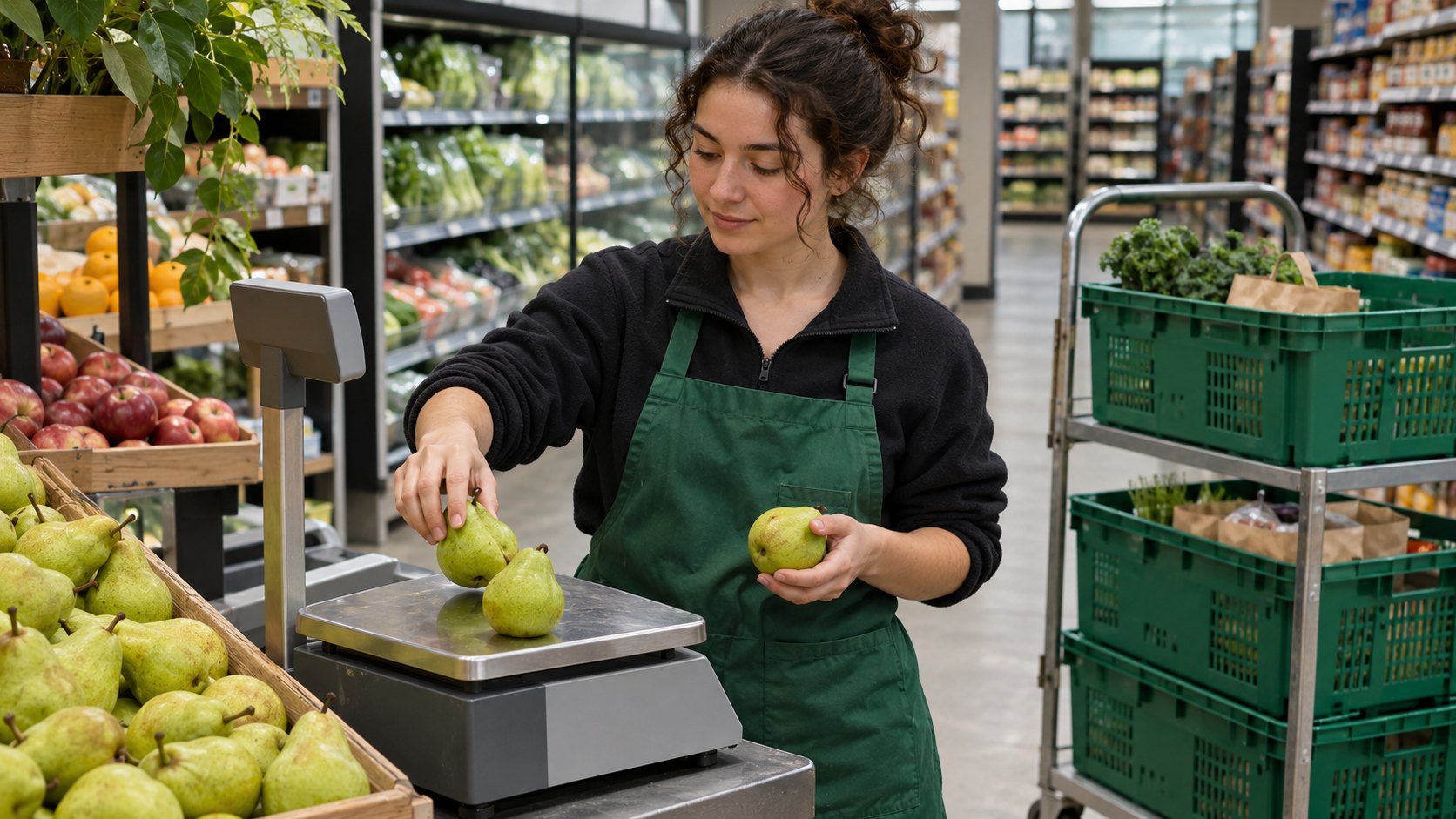
Give the shopper a reliable view of branch, basket and slot
Grocery app development feels useful when a shopper can choose a branch or delivery address, understand the true basket and decide what should happen if a product is unavailable. These operations are harder than a standard catalogue and checkout. A shopper may choose exactly three cans, a weight-based produce line and a preferred substitute whose price or package size differs. The app should record each intended choice and tell the user whether they will review a proposal later. A previous purchase or a visible catalogue row is useful for planning without establishing current stock or price.
This guide follows Orchard Basket, a fictional retailer with two branches and a customer app. The app supports selected fulfilment slots and approved substitution choices. The examples are about shopper-facing interactions, quoted amounts and payment recovery. Detailed stockroom or picking tools belong to the retail operations system. The customer-facing product receives agreed outcomes from it. The example amounts, timings and policies do not describe any real retailer or provider. Validate what your branch partners can supply before advertising the workflow.
Start with a grocery shopper trying to make a repeat purchase on a small phone. They need to know which branch will serve the order, whether the chosen slot is actually retained, and whether previously saved products remain available. When weights or substitutions may change the amount, explain the rule using the specific basket. Provide relevant alternatives and a way to opt out of a proposed substitution. Do not make a sample store web page answer for every product the service can support in the real market.
Make branch assignment and availability visible throughout
Establish where products and prices are being read
The first authoritative choice is which branch or other servicing location your order uses. A physical store and a warehouse can carry different pack sizes, market availability and delivery periods. A delivery address may be eligible for several fulfillment paths, while a pickup selection is expected to use one named branch. Show how the selection changes the basket and the options for pickup or delivery. An unobtrusive branch label during browsing helps. At checkout provide a clear summary, because the product and time are inseparable from the location which can supply them.
Use a stable variant identifier for item sizes and barcodes. A search result may group a brand's products, but selecting a 500 gram bag should not replace the store's 1 kilogram line just because they share a title. An authorized barcode scanner can help match a saved item, with an accessible search fallback for a damaged or unreadable code. A code read identifies a product only under the approved mapping. It does not confirm present branch stock, delivery eligibility or the current customer price. Revalidate on the server before the user accepts the order.
The Shopify InventoryLevel reference illustrates how one commerce platform relates an inventory item to a location and quantities. A grocery service might use that source or a different authorized system. Confirm the actual interface and event meanings under the approved account. Some feeds are delayed snapshots, and a freshly fetched count can still describe what was observed earlier. Choose wording that fits the reliability of the underlying state. Provide a route where customers can find a supported alternative when a desired pack cannot be promised.
Ask about changes when an active cart moves between branches
Orchard Basket saves a reusable shopping list, which is separate from a reviewed purchase offer. When a user switches from Hill branch to Park branch, show which variants and quantities remain available, what changes in service, which discounts still apply and whether a slot needs to be selected again. Preserve their shopping intent if some products are unaffected. Unavailable items can remain on a list for later. They should not remain disguised as purchasable lines at the previous branch's price. Provide a clear review action before using the new offer.
Handle conflicts between multiple devices. A previous install might remember a branch the customer no longer uses. A web view may be in the middle of a separate purchase. Each cart change should have the correct context and expected revision. When the customer's selected branch already changed, ask for review if the new edit no longer applies. Avoid silently routing the accepted order to a store across town. A support owner can inspect when a store changed, which inputs the shopper approved and whether the earlier offer was ever accepted.
Test a store reset halfway through a repeated purchase. Start with a list from last week and set a current pickup branch where one regularly purchased product is unavailable. Show which item caused the change and give a supported action. Swap fulfillment to delivery and require an allowed address. Distinguish an unavailable item from a failed branch service. A customer using assisted navigation should be able to return to the changed line and correct it without relying on a generic banner. Record the accepted offer rather than inferring it from previous activity.
Collect substitution preferences against actual shopping intent
Show the important differences between a selected item and an alternative
An acceptable substitution depends on what the customer wanted. They may accept an equivalent size and different brand, decline any change, or ask to review an option before it is used. Capture the exact decision on eligible cart lines, not only one broad preference buried in account settings. If a budget is part of approval, explain whether the ceiling is per package, measured weight or the entire line. Record which supported action occurs when nobody can review a proposal before the fulfilment deadline.
Display meaningful differences for a proposed alternative. State package size, quantity, relevant product information and price. A comparison of product titles alone may hide the reason a customer declined. Use verified retailer-provided information and original terms rather than assuming that substitutes have equal ingredients or other characteristics. If the store cannot verify a critical detail, explain what is missing and provide a safe supported choice. Avoid approving an alternative simply because its numerical price satisfies a spending ceiling when the person's rule also contains a package or brand requirement.
Give the shopper a way to change a preference before the applicable deadline. Show when it becomes effective. Once a checkout has entered the corresponding fulfillment state, a late edit may need a support route rather than a guaranteed change. A notification can point to the relevant product proposal, but a later click should retrieve current availability and terms. An approved choice for one product should not automatically renew a similar-looking proposal for a future order. Retain the actual reason when a substitution was not applied or when a review period ended.
Explain weights and amounts without claiming a final value too early
Use separate price and unit types for per-item and per-weight values. If the customer asks for roughly 0.75 kilograms of pears at 4 units per kilogram, the illustrated estimate is 3 units. A retailer-confirmed actual quantity of 0.80 kilograms at that same unit price is 3.20 units under the example's rounding assumptions. Show the estimated line and currency before purchase, explain permitted rounding and variation, and show the observed line on the final receipt. When the measured value falls outside an approved window, define whether the shopper must review, the line is removed, or the service needs help from a responsible operator.
Track the shopper's unit request. An interface displaying approximate weight for loose products needs different controls from a package with fixed net quantity. If a customer enters 0.75 and switches locale, preserve the underlying numerical value with the unit. Do not parse a localized decimal again after it was already normalized. Give errors that identify the value to fix and the supported increments. Address accessibility for sliders and gesture controls by providing a readable input option or another method where needed. Prove ordinary rounding with synthetic examples rather than leaving it to two clients to implement independently.
Make promotions and changed totals readable. If a multi-item discount was originally displayed and a refunded or omitted item changes eligibility, document the intended pricing rule with finance and consumer-facing copy. A future cart may recompute the discount. A previously accepted purchase needs its snapshot and recorded adjustments. It may be more appropriate to carry the accepted terms than recalculate an old order without permission. Explain transformation of amounts using the actual supported policy. Avoid representing a candidate coupon as payable in states where it has not been applied.

Rehearse an order with one changed line and one recovered payment
Walk through the synthetic review before approval
In Orchard Basket pickup order OB-18, the shopper requests approximately 0.75 kilograms of pears at 4 fictional units per kilogram and one 500 gram oat package for 5 units. The slot is Park branch at 17:00 to 18:00. The illustrative total is 8 units with no added charge. The shopper approves a measured pear line up to 0.90 kilograms at the stated price and chooses no substitution for the oat package. The order records those boundaries and the slot. The app reports success only when the relevant checkout and inventory results are recorded under the retail policy.
At fulfillment the system reports pears at 0.80 kilograms, inside the approved fixture boundary. The oat package is unavailable and omitted under the chosen rule. The final products in this example amount to 3.20 units. The shopper can see what changed, the original 8-unit estimate and the confirmed receipt once reconciled. A third-party payment method may need a distinct authorization, capture or adjustment process. The actual product should support this only when the retailer and payment integration allow it and finance agrees on when to send receipts.
Extend the fixture with a suggested substitute but no current approval. The shopper previously accepted a similar item for another order. The app can remember a general shopping preference when appropriate. It still must use the approved scope of OB-18. If the item is out of stock and the selected rule says omit it, show the recorded omission. If a separate branch policy allows the shopper to review a proposal, present product version, package size, amount and time for a response. Do not claim the user accepted the latest offer if only a global preference changed earlier.
| Step | Visible decision | Evidence |
|---|---|---|
| Select Park branch | Pickup at 17:00–18:00 | Authorized branch and current slot reference |
| Request pears | 0.75 kg estimate at 4 units per kg | 3-unit estimate and approved maximum weight |
| Add oats | One 500 g pack, 5 units, no substitute | Stable product ID and consent policy |
| Product result | 0.80 kg pears and omitted oats | Approved fulfillment response matched to both original lines |
| Reconciled receipt | 3.20 units after approved change | Final accepted line and confirmed payment record |
Keep booking and financial recovery meaningful
A displayed slot can be a choice or a commitment. State exactly where it becomes retained and whether it expires. A user who picks a window and leaves before review may need to select again, while a confirmed order should remain findable through ordinary recovery. Test changing an address after choosing a slot and reconnecting during acceptance. Do not show an unavailable time as still secured because the app has a cached label. If the checkout could have been accepted while the reply disappeared, retrieve the authorized operation rather than launching a fresh purchase.
The Stripe Payment Intents guide explains provider-specific payment state and changing status. Its webhook guidance discusses asynchronous events for integrations using that provider. Apply the current documented paths and approved permissions if relevant. Treat successful completion of a handset payment flow as an observation, rather than the sole proof of customer payment. Use the merchant's recorded result before presenting a settlement, capture or adjustment as complete. Reconcile event retries to the same operation and accepted basket under the business rules.
Return a short, helpful payment status. A confirmed 3.20-unit purchase, an unresolved adjusted amount and a known rejection should lead to different next steps. Keep the first accepted quote and current decision readable from order history. An approved delay can lead to a review path rather than a retry button that risks duplicate commitments. Give support a way to distinguish a financial adjustment from an item change or unavailable slot. Have a trainee inspect a synthetic case with duplicate payment events and confirm one recorded outcome.
Test the purchase for people using it under ordinary constraints
Include small screens, interrupted sessions and changing stock
Rehearse the whole journey from repeat list to receipt using large text and assisted input. Check variant, branch and size before selecting a product. Try a no-results state and an unreadable barcode with an alternate route. After selecting exact units and estimated weights, review the itemized amounts and service choices. When an offer revision arrives, a shopper should be able to reach the affected line, compare it and select an allowed action. Preserve unmodified choices while the customer repairs one input. Do not hide a critical price or substitution rule inside an unavailable hover annotation.
Replay OB-18 with a lack of network during acceptance. If the confirmed purchase already exists, restore its status before allowing a second order from the same approved interaction. If the slot expired before acceptance, require the user to choose again under the current rules. Show why the time changed. A background service might eventually report the same updated final receipt after the device reconnects. Check that this appears as an update to an existing purchase rather than an unrelated new order. The customer needs an intelligible record even when the user interface and retailer time differ.
Test an alternate account opening an old order link on the household tablet. Check that an authorized buyer can retrieve their order after agreeing to sign in and that someone else sees only approved information. Keep private addresses and shopping history restricted. A device notification should not show more than the selected disclosure and recipient rules allow. Decide what the app retains after sign-out, and explain how private saved lists and receipts can be accessed again through approved identity routes.
Separate source failure and genuine customer decisions in support
Count how often a shopper reaches an outdated availability result, changes a branch before checkout, sees a proposed substitution and accepts or declines it. Measure recovery paths independent of completion. If a weak connection triggers several retries, the number of recorded operations should tell you whether the person could continue. Distinguish price and substitution approval from merchandising impressions. Useful pilot results include a reproducible held-slot transition and a shopper correctly explaining the revised total. Do not judge the first release exclusively by the number of people who loaded a catalogue.
Give a support agent a synthetic customer question about the original 8 units and final 3.20. Require the agent to find the oat omission and approved measured pear price. Ask what the customer would see if the payment had still been unresolved. A correct explanation doesn't require warehouse staff to add an ad hoc comment or finance to guess based on the final amount. Keep limited audit evidence of branches, times, selected conditions and result sources. Review with the team where a change warrants a new customer decision versus a notification.
As a final rehearsal, introduce a second branch with a different supported substitute list and pickup hours. Do not simply copy the first store's operating promises. Confirm serviceability, price source, stock meaning, substitution decision and outcomes with real fixtures under the applicable approval. Some shoppers may prefer to keep an old list rather than move it. Give them a controlled path to retain intent and choose again. The basis for broadening the app is the same evidence that made the first store usable: reachable choices, honest amounts and an order the shopper can retrieve.
Hand the app over with expectations for the next change
Keep examples and versioned store rules in a handover record. Identify who can change shopper substitution limits, which service confirms slots and how the app's financial statuses map to support actions. Record the weak-network rehearsal and accessibility check results. Add a test with the oldest supported app and an ordinary store price change so the client does not make its own assumptions. Product, customer support and engineering should agree on which evidence the buyer sees at each step. A stable foundation makes it easier to add more delivery regions without confusing choices already offered.
Test a slot and choice that arrive through different surfaces
Open a remembered list on a customer phone and start a new order for Park. On another approved surface, simulate the same account changing the default branch. The active cart can either remain fixed to Park or require explicit revalidation under the design, but the person's delivery and price decisions should not change silently. Then open a proposal notification on the first phone. The app should retrieve the specific proposal, show expiry and ask for a fresh action only if the record is still eligible. Document how a proposal sent for an earlier lot or weight will be displayed after a revision.
Let a shopper try selections without an account if that is part of the launch model. Explain which choices will survive sign-in and which must be rechecked. A preferred product list can survive locally under an approved policy, while an authenticated order could require different access and service scope. Confirm the sign-in operation resumes the correct task and doesn't attach someone else's earlier list to the current purchase. If a branch is temporarily unavailable, give the ordinary person a workable recovery without requiring extra private account information when it is not needed.
Use the observed decision to improve product copy. Have a participant explain when they are selecting an alternative compared with actually accepting a revised product or weight. Ask them to show the original amount and final receipt after a reconnect. If they cannot explain why oats were omitted, improve the explanation beside that line rather than making them read a long policy. This turns the numerical fixture into a usability check with a concrete expected outcome.