
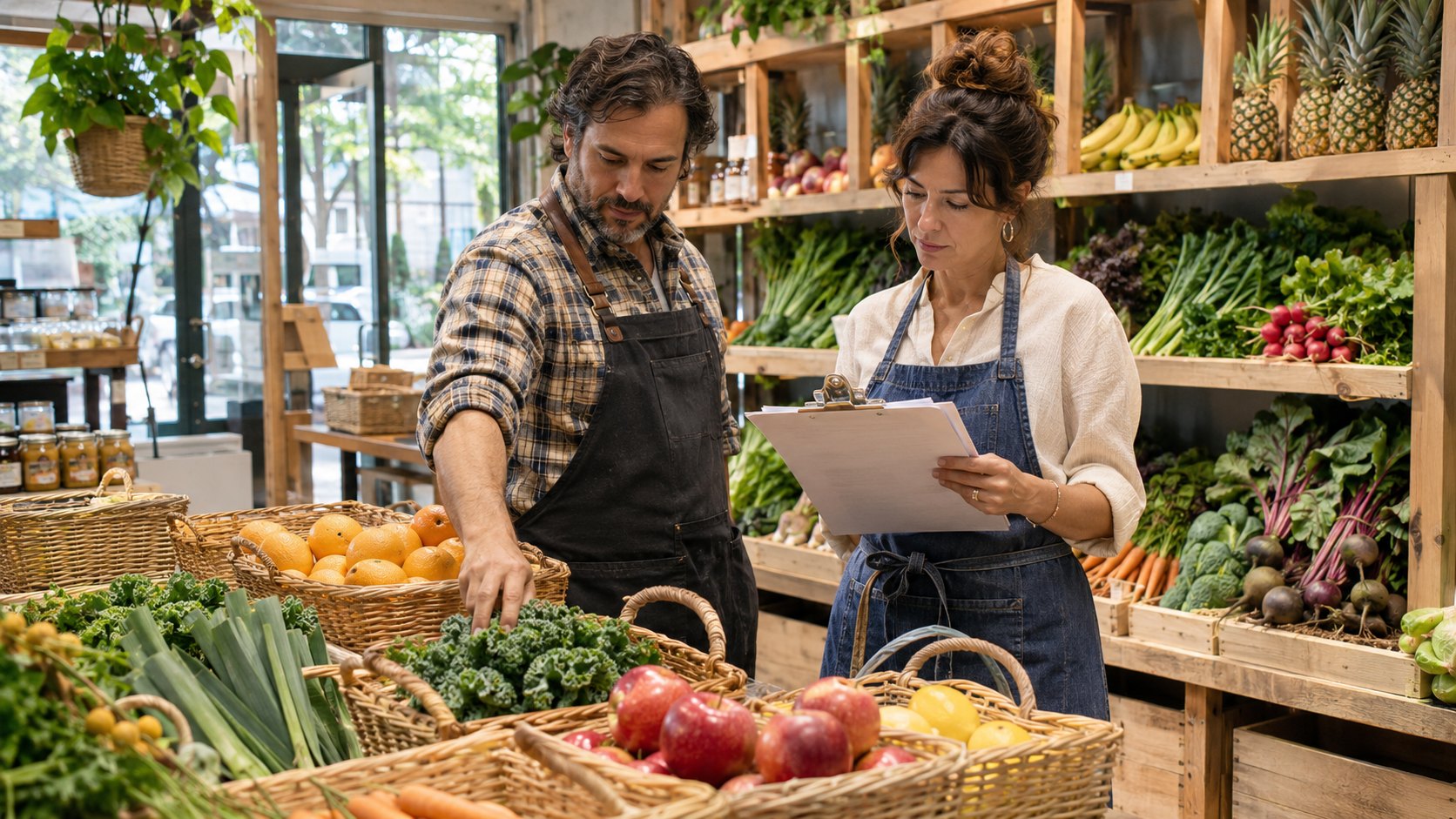
An online grocery delivery business for entrepreneurs is easier to assess when the first question is not how many neighborhoods it could serve, but whether one tightly defined neighborhood can support reliable, repeatable grocery orders. A first-zone pilot replaces broad launch assumptions with observed buying behavior and a ledger that captures costs even when a basket never reaches a customer.
This guide is about the commercial operating test: demand, basket economics, picking effort, stock decisions, cancellations, refunds, promotions, and expansion discipline. It does not evaluate application architecture, available couriers, or the delivery-time promise displayed to shoppers. Those are separate decisions; an attractive ordering experience cannot establish whether fulfillment produces enough contribution to sustain the business.
Define the Business Question Before Opening the Zone
A pilot should answer a decision that can be acted upon: can a limited assortment be sold to identifiable households, picked at a predictable labor cost, and bought again without ever-growing discounts? A count of downloads, inquiries, or checkout attempts is not an adequate answer. The unit of evidence is a fulfilled basket, with an audit trail for every request that did not become one.
Write down the proposed customer, purchasing occasion, shopping alternative, and reason to switch. An apartment household replacing a weekly pantry trip may behave differently from an office ordering emergency milk or snacks. Mixing those occasions makes average basket value and repeat rates hard to interpret. Select one primary use case, then record secondary uses rather than treating all orders as interchangeable.
Before spending on the experiment, document its assumptions, likely customers, competitors, startup obligations, and operating costs. The U.S. Small Business Administration's business-planning resources discuss market research, competitive analysis, business plans, and startup costs. Use that planning framework as a checklist for questions to investigate locally, not as a source of grocery economics or ready-made operating targets.
Choose One Zone and Impose Useful Limits
Draw a Boundary That Can Be Tested
Define the zone by streets, postal blocks, or a mapped perimeter, and check addresses before accepting payment. A vague claim to serve an entire city invites orders that cannot be handled under the same operating conditions. Record rejected out-of-zone requests separately: they may represent future interest, but they do not belong in current-zone conversion or fulfillment performance.
Specify operating days, order windows, product categories, maximum active baskets, and a substitution policy. Freeze the basic terms long enough to compare like with like. A founder who changes fees, assortment, radius, and discounts every few days cannot know which change caused an improvement. Any necessary intervention should carry a date and reason in the pilot log.
Constrain Assortment and Inventory Exposure
Start with goods that match the intended shopping occasion, including essentials, a few produce choices, and a manageable set of household items. Set a maximum number of listed products, a minimum basket value if appropriate, and a replenishment rhythm. More variety can increase perceived choice but also raises the work of stock checking, substitution conversations, spoilage monitoring, and supplier coordination.
Decide whether stock is owned, reserved through a partner store, or bought against confirmed demand. These arrangements shift the location of inventory risk, but none removes the need to measure unavailable items and missed substitutions. Track shelf availability at the time of picking, not merely whether a product was listed earlier in the day.
Keep a short exception register for perishables: rejected produce, temperature concerns, damaged containers, and items too near an internal freshness cutoff. The goal is not to make broad food-safety claims. It is to see what inventory is discarded, what replacement is required, and who bears each cost. Verify applicable local food, licensing, labor, tax, and consumer rules separately before operating.
Price the Entire Basket, Not Just the Delivery
The customer sees item prices, any service or delivery fee, and any discount. The operator must see a different stack: supplier cost, pick-and-pack labor, packaging, dispatch expense, payment charges, shrink, refunds, promotion, and overhead. Leaving picking time out of this stack can make a busy service look healthier than it is.
Record Pick-and-Pack Work as Paid Minutes
Measure when a worker starts locating items, checks quality, considers substitutes, packs the basket, and labels it for handoff. Use actual paid time or an appropriately allocated paid-labor measure; do not value the founder's recurring work at zero simply because no wage is withdrawn. Separate fixed shift coverage from per-basket activity so labor is not counted twice.
Picking capacity should be expressed in labor minutes available per service period, with a buffer for cleaning, restocking, receiving supplies, and exceptions. A maximum number of customer-facing slots does not automatically equal maximum baskets that staff can pick. Test those two ceilings independently, and close a window when either constraint is reached.
Recognize Costs Attached to Failures
Some accepted orders consume labor and materials before cancellation. Their picking minutes remain a real cost; if perishable items cannot be returned to sale, the write-off remains too. Refunds for missing or damaged delivered items reduce the net receipts of otherwise fulfilled baskets. Successful payment reversals may still involve processing costs depending on the applicable agreement; record what the actual statements show.
Calculate costs using a consistent denominator. Supplier cost per fulfilled basket describes merchandise sold. Picking labor per fulfilled basket should include time spent on baskets that were picked but later cancelled. For a complete contribution calculation, divide all pilot-period order-related costs by fulfilled baskets, while also reporting rejected and cancelled requests as separate rates.
Build a Cancellation Ledger That Distinguishes Causes
A single cancellation percentage hides operationally different problems. An address outside the zone should be declined before acceptance. A payment that does not clear, a customer who changes plans, an unavailable key product, and a quality failure need distinct reason codes. Each category points to a different change in policy or execution.
Use a stable sequence: requested, rejected before acceptance, accepted, cancelled before picking, picking started, cancelled after picking, and fulfilled. Store the timestamp and owner of every status change. Do not label a refused checkout as a cancelled order simply to make an acceptance rate appear better; do not label an undelivered accepted order as fulfilled merely because a picker prepared it.
Track the customer's stated reason alongside the business-verified reason, especially for substitutions. A customer may select “changed my mind” after several unavailable items. An operator may record “stock failure” even when the customer rejected a clearly explained replacement. Reviewing a small sample of disputed cases improves the usefulness of the categories without concealing uncertainty.
For every cancellation, capture any supplier commitment, handling time, packaging consumed, payment reversal, waste, and compensation offered. Separate full refunds on unfulfilled orders from partial refunds on completed orders. The latter should remain connected to the original fulfilled basket so revenue, quality, and repeat-purchase analysis reconcile.
Worked Hypothetical: A Four-Week Neighborhood Grocery Pilot
Everything in this example is fabricated for illustration. “Maple Block Grocery” is an invented operator, not an actual customer or a reported industry case. All prices, labor times, demand volumes, and thresholds below are choices made for this fictional test. They are neither market benchmarks nor a forecast of what another founder should earn.
Rules Established Before the First Order
Maple Block chooses a 2.5-kilometer service perimeter, 180 listed products, and a 28-day trial with 24 service days. It offers two fulfillment waves per day and at most six completed baskets in each wave: 12 daily slots, or 288 across the trial. It uses a single grocery sourcing arrangement, keeps the delivery fee at $3, and records every price reduction. For easy arithmetic, every currency amount is in fictional US-dollar equivalents.
The operator initially receives 300 genuine order requests. It rejects 24 before acceptance: 16 because the requested waves are full and eight because the address lies outside the boundary. Thus 276 are accepted. Twenty accepted orders stop before picking: eight payment failures, six customers withdrawing, and six stock-confirmation failures. Picking begins for 256 orders.
Another 16 orders end after picking begins: ten because a critical item is unavailable and the customer declines alternatives, four because the customer cancels after the cutoff, and two because product condition fails inspection. That leaves exactly 240 fulfilled baskets. Total accepted-order cancellations are 36; the accepted-to-fulfilled rate is 240 divided by 276, or approximately 87.0%. Rejections are reported separately as 24 divided by 300 requests, or 8.0%.
Reconcile Income, Labor, Promotions, and Losses
The 240 completed baskets average $42 in merchandise before discounts and carry a $3 delivery fee. Nominal merchandise sales are $10,080 and nominal delivery fees are $720. Eighty fulfilled first-time orders receive a $4 discount, reducing receipts by $320. Five fulfilled baskets require $8 partial refunds, reducing receipts by another $40. Net sales collected or retained are therefore $10,440, or $43.50 per completed basket.
The merchandise acquired for those fulfilled baskets costs $28 each, or $6,720. Pickers spend an assumed 15 paid minutes on every one of the 256 baskets that enter picking, including those later cancelled. That is 64 paid hours at a chosen loaded rate of $15, costing $960. Packaging prepared for those 256 baskets costs $0.75 each, or $192. Assigning picking and packing only to the 240 successes would erase labor and supply expenses created by failed orders.
Delivery service costs $5.50 for each completed basket, totaling $1,320. The operator records $0.90 in payment charges per completed basket, totaling $216. Sixteen post-pick cancellations produce an assumed combined $120 of unsaleable goods, after any recovery. A controlled neighborhood outreach test costs $360, separate from the $320 of customer discounts. No additional cancellation transaction fees are assumed in this invented ledger.
| Ledger line | Calculation or treatment | Pilot amount |
|---|---|---|
| Merchandise at listed prices | 240 × $42 | $10,080 |
| Delivery fees | 240 × $3 | $720 |
| First-order discounts | 80 × $4; deducted from revenue | −$320 |
| Partial post-delivery refunds | 5 × $8; deducted from revenue | −$40 |
| Net sales retained | Listed sales and fees, less discounts and refunds | $10,440 |
| Cost of fulfilled merchandise | 240 × $28 | −$6,720 |
| Picking and packing labor | 256 × 15 minutes × $15 per hour | −$960 |
| Packaging materials | 256 × $0.75 | −$192 |
| Delivery expense | 240 × $5.50 | −$1,320 |
| Payment processing | 240 × $0.90 | −$216 |
| Unrecoverable stock after cancellation | Recorded write-offs | −$120 |
| Neighborhood outreach | Separate from order discounts | −$360 |
| Contribution before fixed allocation | $10,440 less $9,888 in operating and outreach costs | $552 |
| Fixed pilot allocation | $400 storage and utilities; $240 oversight | −$640 |
| Result after stated fixed costs | $552 less $640 | −$88 |
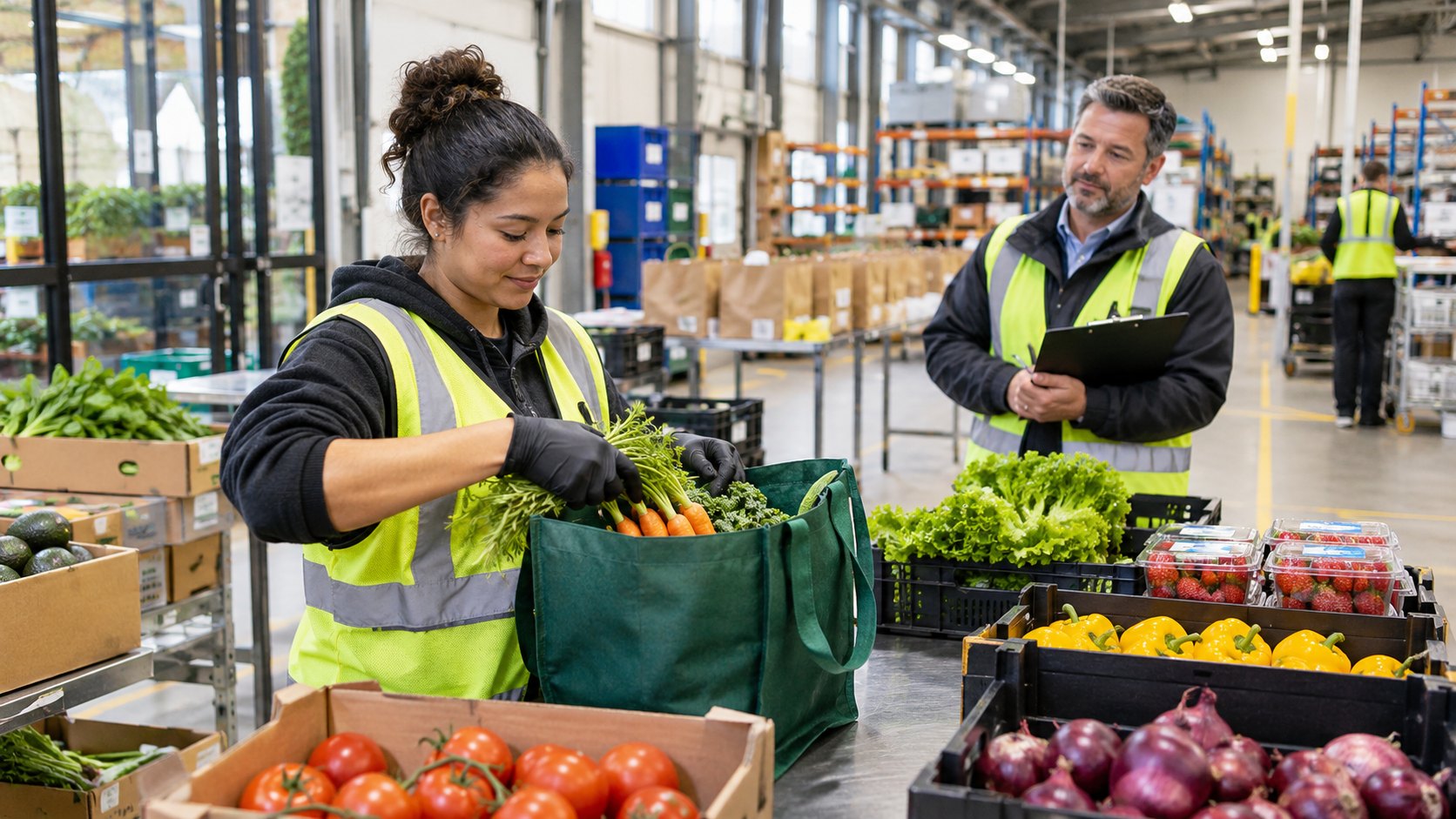
The order-related operating and outreach costs sum to $9,888, or $41.20 per fulfilled basket. That includes $28 merchandise, $4 picking labor, $0.80 packaging, $5.50 delivery, $0.90 processing, $0.50 stock loss, and $1.50 outreach per completed order. After discounts and partial refunds, retained revenue is $43.50 per basket, leaving $2.30 contribution before fixed allocation. The $640 fixed allocation adds approximately $2.67 per basket in costs, resulting in a loss of about $0.37 per fulfilled basket, or $88 overall. The operator must not deduct the $320 discount or $40 refund again after using net revenue.
This result includes only the stated operating lines and two fixed allocations. It excludes initial equipment purchases, financing, taxes, founder capital, and any unlisted obligations. It is not a claim that the hypothetical business has achieved accounting profitability or that its assortment economics will persist when conditions change.
Check Service Capacity Against the Actual Workload
The 288 advertised slots across the service days do not prove that 288 orders were economically feasible. Maple Block picked 256, or about 10.7 baskets per service day, and fulfilled 240, or ten per day. Sixteen requests were rejected because a particular wave was already full; spare slots on another day could not satisfy those customers' chosen shopping occasion.
The paid picking requirement was 64 hours across 24 days, averaging roughly two hours and 40 minutes per service day. That average conceals rush-hour bunching, receiving work, and difficult substitutions. Examine picking minutes by wave and weekday; an overall average cannot show whether staff consistently finish a peak wave without overtime or shortcuts.
Keep two reports: available slots versus requested slots, and available paid picking minutes versus minutes actually consumed. If more orders arrive at peak than the picker can handle, adding customer slots alone does not create capacity. If labor is underused during quiet waves, the operator might first consolidate windows, rearrange staffing, or redirect existing customers rather than immediately adding a second zone.
Measure Repeat Purchasing Without Counting Curiosity as Loyalty
First orders are evidence of trial, not enduring demand. Track unique customers, first paid and fulfilled orders, second fulfilled orders, time between orders, discounts on each purchase, and the composition of repeat baskets. Exclude test transactions, duplicated accounts that are known to belong to the same household, and cancelled requests. A second checkout attempt that never fulfills is not a repeat purchase.
Maple Block's 240 fulfilled baskets come from 190 unique purchasing households. Forty households buy a second time, and ten of those buy a third time: 190 first purchases plus 40 second purchases plus ten third purchases equals 240 baskets. A simple whole-pilot repeat-buyer share is 40 divided by 190, or about 21.1%, but late joiners had less opportunity to return.
For a more comparable observation window, the operator identifies 120 households whose first purchase occurred during the first 14 days. Of those, 30 place another fulfilled order within 14 days of their first. The defined 14-day repeat-purchase rate is 25.0%. The other 70 households made their first purchases later, so the pilot cannot yet observe all of them for a full 14 days.
Segment these cohorts by promotional exposure. A second order bought only after another steep discount is commercially different from an unsubsidized repeat basket. Track the second basket's net revenue, pick minutes, margin, and any refund separately. For a short test, report the observed results and the limited follow-up period rather than projecting a customer lifetime value from thin evidence.
Decide Whether Promotion Creates Demand or Merely Discounts It
A promotional budget needs a hypothesis and a ceiling. The $360 outreach expense in this example is a deliberate experiment to reach households in the defined service perimeter. The $320 order-discount expense is a separate incentive used on 80 fulfilled first-time orders. Together they cost $680, but they answer different questions: how many prospects can be reached and how much revenue is surrendered to encourage trial.
Do not divide the entire $680 by 190 customers and call the answer an acquisition cost unless the operator can show those customers were attributable to the campaign. Some may have found the service independently, been existing store customers, or received word-of-mouth recommendations. Track unique codes, referral mentions, neighborhood source questions, and non-promoted orders with the same definitions.
Compare promotional and non-promotional customers on subsequent orders, basket mix, refund rate, and picking time. A discount may attract baskets heavy in low-margin items or customers who never return at the normal price. Conversely, one first-order incentive might introduce customers who continue buying without assistance. The pilot should capture which story the records support, without presenting correlation as proof of causation.
For an expansion decision, hold the same fees and targeted promotions during a final observation interval whenever practical. If volume collapses immediately when offers stop, record that as a commercial dependency. The point is not to ban promotions, but to prevent them from concealing the ordinary cost of winning a fulfilled and potentially repeatable basket.
Set the Expansion Decision Before the Numbers Arrive
Use Thresholds the Operator Owns
Maple Block preselects decision gates for this single invented pilot: at least 220 fulfilled baskets; contribution of at least $2 per fulfilled basket before the fixed allocation; no more than 8% accepted-order cancellations; at least a 30% 14-day repeat rate among customers with a full observation window; at least 97% correct fulfilled orders; and combined outreach plus discounts of no more than $700. These are scenario-specific management rules, not suggested industry norms.
The fictional operator records 235 fully correct orders out of 240, or roughly 97.9%, using its stated definition of correct item, quantity, and acceptable condition. Volume passes at 240 baskets. Contribution passes at $2.30. Accuracy passes, and promotion fits within the $700 cap at $680. However, 36 cancellations divided by 276 accepted orders equals about 13.0%, above the 8% ceiling. Fourteen-day repeat is 25%, below the 30% floor.
The preset decision is therefore do not expand the service area yet. A positive contribution before fixed costs is not permission to ignore failed orders, weak repeat purchasing, or the $88 loss after the defined fixed allocation. Nor should a founder move the thresholds after seeing results simply to declare a successful launch.
Specify the Retest, Not Just the Rejection
Maple Block will remain in the original zone for another defined trial. It will review the 16 stock-related cancellations among accepted orders, tighten stock confirmation for frequently missing items, and make the substitution decision earlier. It will also examine the ten customer-initiated cancellations for confusing order cutoffs or poor expectation setting, while keeping those causes distinct from the eight failed payments and two quality rejections.
The operator then repeats the same core measures under stable prices and documents changes in picking minutes and repeat behavior. If the second trial clears the original gates and covers the costs the operator expects an added zone to create, it can evaluate a controlled adjacent-area test. Passing a first-zone threshold alone would not prove that a new zone has similar household density, supplier economics, labor availability, or buying patterns.
Turn the Pilot Into a Decision Record
Maintain one daily ledger with request identifier, anonymized household identifier, service window, in-zone eligibility, accepted status, rejection or cancellation code, picking start and finish, item count, payment outcome, discount, refund, supplier cost, packaging, delivery charge and expense, and whether the basket was fulfilled. Reconcile it against payroll, inventory write-offs, payment statements, and outreach invoices at least weekly.
Alongside totals, maintain a short narrative of changes: a supplier missed a replenishment, a product category created excessive substitutions, or one promotional channel brought repeat buyers. Annotate the dates so an apparent improvement is not credited to a change that happened afterward. Preserve original counts rather than overwriting rejected and cancelled records when an order is retried.
At the review meeting, ask whether demand fits the intended shopping occasion, whether picking work remains manageable at the busiest wave, whether costs were captured for unsuccessful orders, and whether customers buy again at viable terms. Review the reasons for exceptions before debating a larger territory. Expansion should be a response to evidence, not a substitute for resolving instability.
For someone considering an online grocery delivery business for entrepreneurs, the strongest first-zone result is a defensible decision. That decision may be to extend the pilot, simplify products, improve purchasing discipline, alter labor coverage, or stop. A small zone that reveals the true economics of each fulfilled basket is more informative than a broad launch that cannot explain where its money and customers went.