

Make the online order understandable to the people picking it
Online grocery store software has to describe what a customer chose and what the store can put in their bag. Those can be different facts. A pack can sell out between browsing and picking. A pear sold by weight may cost slightly more or less than an estimate. A customer may accept a different pack size for a staple but decline a substitute for a particular product. Design the basket, picker view and final receipt so these ordinary changes have a clear outcome. A single inventory counter or generic ecommerce return screen will not explain them.
This guide follows a fictional local shop called Oak Street. It uses one store, one pick team and a small delivery operation. Large chains, multi-seller markets and delivery aggregators may need different contracts and routing. The design questions here start at the store level. Identify which sellable units exist, what can be substituted, how the customer authorises a material change, when the store promises a delivery slot and which approved payment conditions apply. Then test those decisions on the same five-line order used by the customer, picker and duty manager.
Know whether a product is a pack, a count or a weight
Keep a product identity for the item customers recognise and a separate sellable unit for the version the store offers. A six-pack, a single bottle and a case may belong to the same catalogue family but carry different prices, quantities and inventory units. Schema.org’s Product type explains vocabulary a retailer can use when describing products publicly. Public product metadata is not a transaction record. Preserve the exact sellable unit, store, description snapshot, pricing basis and fulfilment terms on each accepted order line.
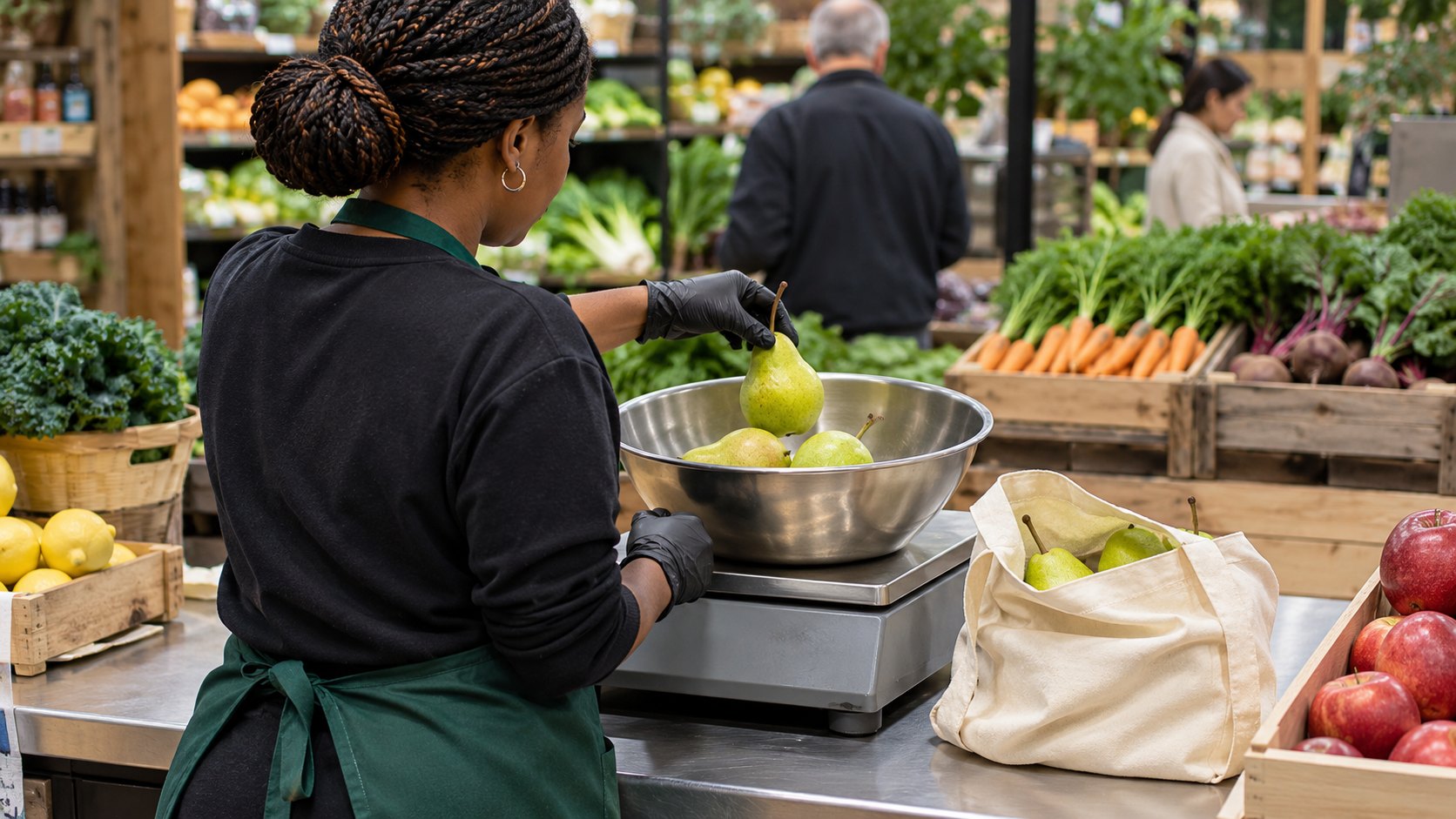
For weighed goods, decide the basis used to display price and quantity. A customer choosing 0.75 kilograms of loose pears is making a different request from someone buying three prepacked punnets. The cart can show a price per kilogram, estimated weight, estimated amount and the relevant limit on change. Record actual approved weight from the picker’s entry and link it to the chosen product. Use the store’s authorised unit and rounding policy. A final receipt should explain the measured weight and resulting amount without making the shopper infer why the estimate changed.
Some stock systems provide a live physical count. Others provide an inventory snapshot corrected by point-of-sale and replenishment activity at different times. Show what the application can honestly promise based on that source. Local reservations can prevent overlapping online commitments when they are supported, but they cannot fully control unknown walk-in purchases or a disconnected scale. Agree when pickers must confirm an item physically and how stock corrections are routed. Treat scanning, reserving and physically placing an item into the order as distinct steps where staff need those facts for support.
Separate substitution permission from the picker’s proposed replacement
Give customers meaningful per-line preferences
Allow the shopper to choose what should happen if a product is unavailable. Possible policies include no substitute, an explicitly approved alternative, a controlled suggestion requiring a new decision or a bounded substitution under an accepted store policy. The actual choices should reflect the retailer’s products and fulfilment arrangements. An instruction on one product need not apply to the rest of the basket. Store the setting on the individual line and let the customer review it before the order becomes operational. An optional user interface label such as similar item needs a business definition that pickers can follow.
Pay special attention to products where a seemingly similar item may differ in important ingredients, packaging or usage. Do not infer suitability based only on a shared category or product photograph. Where the retailer supports handling preference or ingredient information, take it from the accepted source, show it to the authorised person and follow the documented substitution criteria. If the picker cannot determine whether an alternative meets the approved conditions, select the review path rather than presenting an unsupported guarantee. Keep the exact proposed product and any known price or pack size difference visible before the customer decides.
Store any spend ceiling with its basis. A shopper may allow an increase of up to 0.50 on the line or only choose candidates no more expensive than the original. A limit expressed per pack differs from a limit expressed per unit weight. Include the price and availability of the actual candidate at the time the picker proposes it. Apply the limit and any explicit consent rules using a structured calculation, not a manual comparison of label strings. If a proposed alternative must wait for the customer, show the time by which the store needs their answer and what the agreed default outcome will be.
Limit what happens automatically after the answer window ends
A picking deadline may arrive without a reply. The default should be the service outcome disclosed for the relevant line and approved by the retailer, such as removing a candidate that needs new consent. Do not interpret a customer’s silence as approval unless the policy specifically and lawfully supports that path. When a message is delayed, retain the original proposal identity, customer response and decision timestamp so the store can identify whether it was accepted in time. A second response should not undo a later authorised decision or reintroduce an item into a sealed bag.
Present a picker with alternatives they can realistically retrieve before the order cut-off. If the preferred candidate becomes unavailable while waiting for consent, mark the original proposal superseded and explain the next option if appropriate. The same “approve” action should not apply to a new variant after a different candidate reuses its position in the list. Identify each proposal independently and verify that the order is still eligible for change. Have a supervisor review an unusual case such as a call to support giving a different instruction from a customer’s signed-in message.
Run Oak Street’s five-line order from shelf to receipt
Use currency units for this simplified fixture and omit taxes, fees and promotional rules that would vary by shop and jurisdiction. Oak Street accepts a proposed grocery order with milk at 2.40, bread at 1.80, pears estimated at 0.75 kg at 4.00 per kilogram, rice at 3.20 and a jar of sauce at 2.10. The estimate is 12.50 before any delivery amount. The customer allows a bread substitute with a limit of 2.10, allows the pear line to vary within a stated margin and marks rice as do not substitute. The other two lines can be picked as ordered.
At the shelf, the milk and sauce are present. A different bread pack at 2.00 is available and meets the permitted conditions in the fixture. Oak Street requests explicit approval through the documented response window. The customer approves on time. The pear weight is 0.80 kg for 3.20 and stays within the approved range. Rice is unavailable, so the picker removes it under the customer’s instruction. The actual merchandise sum is 2.40 plus 2.00 plus 3.20 plus 2.10, which is 9.70. The final picker evidence records four fulfilled lines and one short line rather than claiming all five were fulfilled.
| Line | Estimated amount | Final outcome | Actual amount |
|---|---|---|---|
| Milk | 2.40 | Original pack picked | 2.40 |
| Bread | 1.80 | Approved 2.00 substitute within 2.10 ceiling | 2.00 |
| Pears | 3.00 | 0.80 kg at 4.00 per kg within the accepted allowance | 3.20 |
| Rice | 3.20 | Unavailable and no substitute permitted | 0.00 |
| Sauce | 2.10 | Original jar picked | 2.10 |
| Merchandise total | 12.50 | Four fulfilled lines | 9.70 |
Keep the revised order and payment decision separate
A picker can propose and verify the shop’s actual items. The payment integration still determines whether and how the new total is authorised and captured. Stripe’s guide to placing a hold on a payment method describes an example provider’s authorisation and later capture workflow for supported configurations and methods. Verify the separate rules, deadlines and capabilities for your provider. An application should not assume it can increase the captured amount, keep a hold indefinitely or use a second authorisation to solve every change. Capture evidence around the approved financial decision.
For Oak Street, assume a provider-approved hold and a permitted final capture of 9.70 for merchandise in the fixture, with other charges excluded. If the active authorisation expired during picking, the actual business response would depend on the approved payment and fulfilment plan. Contractual and payment rules should guide whether to request renewed confirmation, stop fulfilment or hand off to an authorised process. The application needs to show that condition to the duty manager and prevent an unauthorised charge. Show captured, pending and released amounts separately when reconciling the final total.
Try the same order with the bread proposal coming in above the allowed ceiling. The cashier or operational reviewer should see why the shopper’s previous instruction cannot cover it. Give the customer the supported review choice while the order is still open, or remove it under the disclosed policy. If someone approves a proposal from an older notification after a new item supersedes it, verify the reference and current state. This prevents a late click from accepting something that was not described in the message or moving a completed order back into picking.
Coordinate picker capacity and the promised delivery or pickup window
A slot is an operational commitment that can depend on the shop, delivery area, available drivers, fulfilment capacity and ordering deadline. Separate a slot shown on the screen from one reserved or accepted for the order. An open slot may disappear while the user compares products. An accepted window can still face a disruption. Store the policy used at acceptance and retain the reason when an authorised operator changes it. Live routing and payment should never silently move a customer to a different store if products, minimum order or conditions change.
When a customer chooses a store or postcode, identify which site can fulfil the full basket and promised handover. A shop with the appropriate slot may not have every item eligible for delivery. Use the actual constraints and store ordering policy rather than counting theoretical driver seats. A slot reservation may have its own expiry during checkout. If the order was accepted but payment is still being verified, establish which operation owns the slot and how a failed acceptance frees the relevant capacity. Keep an audit event so two concurrent checkouts cannot make it appear that a single delivery capacity was promised twice.
Use a workable sequence on the picker’s device
At minimum, show each item with identifying information, the expected pack size or weight, quantity and the current allowed substitution path. Keep the device workflow short when a product is present. Provide a meaningful action for wrong pack, short quantity, damage, proposal sent and no approved replacement. For items weighed at the shelf, verify the measurement and clear the input if the unit reference changes. The picker needs the final count and reasons to complete a bag. Customer service needs the record of which shipped goods are associated with the correct order and pick decision.
Design bag staging around the retailer’s physical workflow. Some orders have several bags, separate temperature handling or more than one person picking. Define how the packer can verify which portion is ready and where to locate it. The driver or handover staff should only see the information needed for the authorised delivery. They may require the confirmed number of packages and delivery instruction while private pricing or the reason for excluding a sensitive product serves no purpose in that view. Record what was handed over and preserve applicable exception routes.
Explain late and incomplete orders without guessing at current stock
An operator handling a delayed order should see the accepted slot, last confirmed picking action and location of an outstanding item. A user cannot tell whether a delayed text refers to product approval, traffic movement or a failed pickup from one generic status label. Provide clear customer updates when an approved decision changes their expectation. A contact attempt is not proof that the customer received the message. Where delivery or pickup uses a partner, match its supported status to the correct order and preserve the source of the final handover observation.
Build accessibility and review into normal operations
The product detail and substitution actions should work as a coherent journey with keyboard and touch use. WCAG 2.2 describes web accessibility guidance relevant to forms, status feedback and navigation. Test a customer comparing package sizes on a narrow device, editing a no-substitute preference, reviewing a time-sensitive proposal and finding the final receipt. Put the important price difference and category in text. A notice that changes colour or automatically disappears may not explain why an order line is affected. Provide an authorised help route where the online response path is unsuitable.
Collect only the needed contact information and share it across approved tools and roles. A picker can work from order and product references without seeing a customer’s full address. Delivery may need the appropriate address and authorised access notes at the right time. Keep private payment information out of CRM notes and reports. Test permission changes as part of the rollout, including a temporary picker who finishes a shift, an incorrect user opening a substitution message or a care employee investigating two closely named orders. Determine how long the operation needs to retain each record under its actual policies.
Measure quality from the list of items customers actually receive
Track how often items were physically unavailable after acceptance, what substitutions were proposed, which were approved and how many required care follow-up. Keep the unreplaced-out-of-stock count distinct from a more expensive replacement or a product weight difference. A high picking rate can hide frequent customer support issues. Try reports by store, product family and time window, with reason categories documented. Start from the complete expected set and reconcile the confirmed result rather than counting whichever events the application logged most recently. Operators need a metric they can improve through catalogue, stock accuracy or service practice.
In a pilot, hand the Oak Street fixture to a cashier, a picker, an operations supervisor and a help team. Ask them to trace the 12.50 estimate, the approved bread replacement, the measured 3.20 pear line and the 9.70 final merchandise total. Repeat with an expired delivery hold and an unavailable substitute. Confirm that each person can explain one permitted decision without seeing unrelated information. The aim is to verify that a real store can manage an imperfect basket from the first shelf scan through a trusted receipt.
Check what happens when an order changes after pickup starts
Run a second test where the store finds an order bag incorrectly assigned to the pickup shelf. The item history and packing references should let an authorised worker isolate the affected bag and confirm the original intended handover. The customer’s final receipt must not change merely because an employee moved the order to another shelf. If the incident requires a replacement or payment adjustment, it needs a distinct approved process with an accountable actor. Make sure the event history can describe an operational correction without presenting it as a customer-approved change.
Finally, test a store inventory correction after a product was wrongly reported unavailable. Releasing physical stock for future baskets does not retroactively change a closed order or the receipt amount. Keep the operation’s record of what the picker actually saw at the time and identify the subsequent correction as a new event. Add a quality review where a supervisor samples several similar cases before changing an inventory policy. A reliable grocery implementation is judged by the accuracy and explanation of the final order, even when the exact basket displayed during browsing cannot be collected unchanged.
Distinguish a product issue from a delivery recovery
A shopper may report that the accepted bread substitute was absent after the delivery was completed. The duty manager should retrieve the accepted replacement identity, the time the consent was recorded, the scan at pick, the bag identifier and the delivery evidence that is relevant to the case. Customer care can investigate a missing item without reversing the full order. If the package was handed over intact but the bread never reached the bag, the relevant operations response is different from a bag that was not delivered. Keep the two hypotheses and their evidence separate while resolving the customer’s issue through the approved policy.
The stock team may also discover that a scanning device accepted a different pack with a similar printed product identifier. A controlled catalogue correction can connect the expected product to a proper sellable unit and block the erroneous mapping for new orders. Preserve the original comparison carefully so the operator can explain what the customer accepted. An automatic merge based on a familiar product name can create the same acceptance error for every newer basket. Test correction and picker scanning using two variants with the same brand and different counts, then confirm that the correct quantity and price basis are used.
In a mixed temperature order, note when a bag is still under the store’s control and where the driver may collect it. A return to the shop after an unsuccessful delivery creates a custody event and an authorised assessment. It does not automatically make the original order ready to resell or require a generic refund. Follow the shop’s approved product handling procedures, and make a separate operational decision for each part of the order where appropriate. The application should record which employee entered evidence and which supervisor approved a material departure from the normal case.
Test a customer opening the final receipt through a new browser on a shared device. The receipt must expose only information their access allows, and it should clearly compare the requested bread and accepted substitute. Provide an unambiguous way to see that rice was not charged in the fictional example. If the receipt is exported to an approved finance destination, include the recorded amount and identifiers needed to reconcile the transaction while leaving out unnecessary customer instructions. Show how a support adjustment is reported independently of the original sale for traceability.
Include one register correction after a store changes a promotional label late in the day. Make the reviewed correction visible to the operating team before changing future sellable prices. A historical order should continue to show which version and explanation the customer accepted. The pilot should end when the team can reliably distinguish estimated basket, final fulfilment and resolved financial outcome for the same transaction.