

Comparing hotel property management systems products and features becomes practical when an independent property asks each implementation team to run the same night audit. A search demonstration can show a booking. An overnight handover tests which rooms will really be ready in the morning, which transactions belong to the closing day and which exceptions have a clear owner. Start with one operating date and representative data, including an arrival delayed until after midnight. Use the same small script with all candidates so staff can tell whether each product fits the property's real working hours and responsibilities.
Describe the overnight handover before making a product shortlist
Consider a fictional 36-room hotel, Cedar Court. On Friday evening room 202 is reserved for a late arrival, room 206 has a guest who is extending one night, and room 311 was marked for inspection after a maintenance visit. The front desk has one card transaction awaiting a confirmed result. A supervisor expects the day to close with a traceable balance and needs a report listing unresolved operations. The night auditor must be able to find all four issues using the usual permissions. The opening receptionist should see which facts were confirmed and which still need an answer.
Give vendors the current property workflow through their designated sales and implementation contacts. Identify the people who confirm arrivals, the staff allowed to post adjustments and the roles responsible for cleaning and accepting rooms back into use. The hotel should decide whether the night procedure reviews work prepared throughout the day or discovers it all at once. This distinction affects the workload and the design of reminders. An appropriate platform centralises the evidence people need while preserving who is authorised to make each decision.
Use a supplier guide to choose questions about business date
The Oracle OPERA Cloud End of Day guide documents one product family's setup options, procedures and reports. Its guide to managing a business date provides another example of an explicit administrative function. These help explain why the operating date is a product concept alongside clock time. Work through the date procedure and escalation for the actual product, deployed edition and hotel policy. Ask which tasks can continue while an authorised employee resolves an exception.
| Property condition | Evidence the reviewer needs | Expected handover |
|---|---|---|
| Guest in room 202 has not arrived by midnight | Stay date, guarantee status and visible late-arrival instruction | Keep the operating decision with the correct shift and leave a usable note |
| Guest requests one extra night in room 206 | Original checkout date and an authorised extension with checked availability | Preserve both dates and determine the next cleaning visit |
| Room 311 is still awaiting inspection | Maintenance closure reason, condition note and inspection responsibility | Show any restrictions before the next arrival plan is accepted |
| One electronic payment remains under review | Original attempt and latest authoritative response | Assign a follow-up without applying an extra payment |
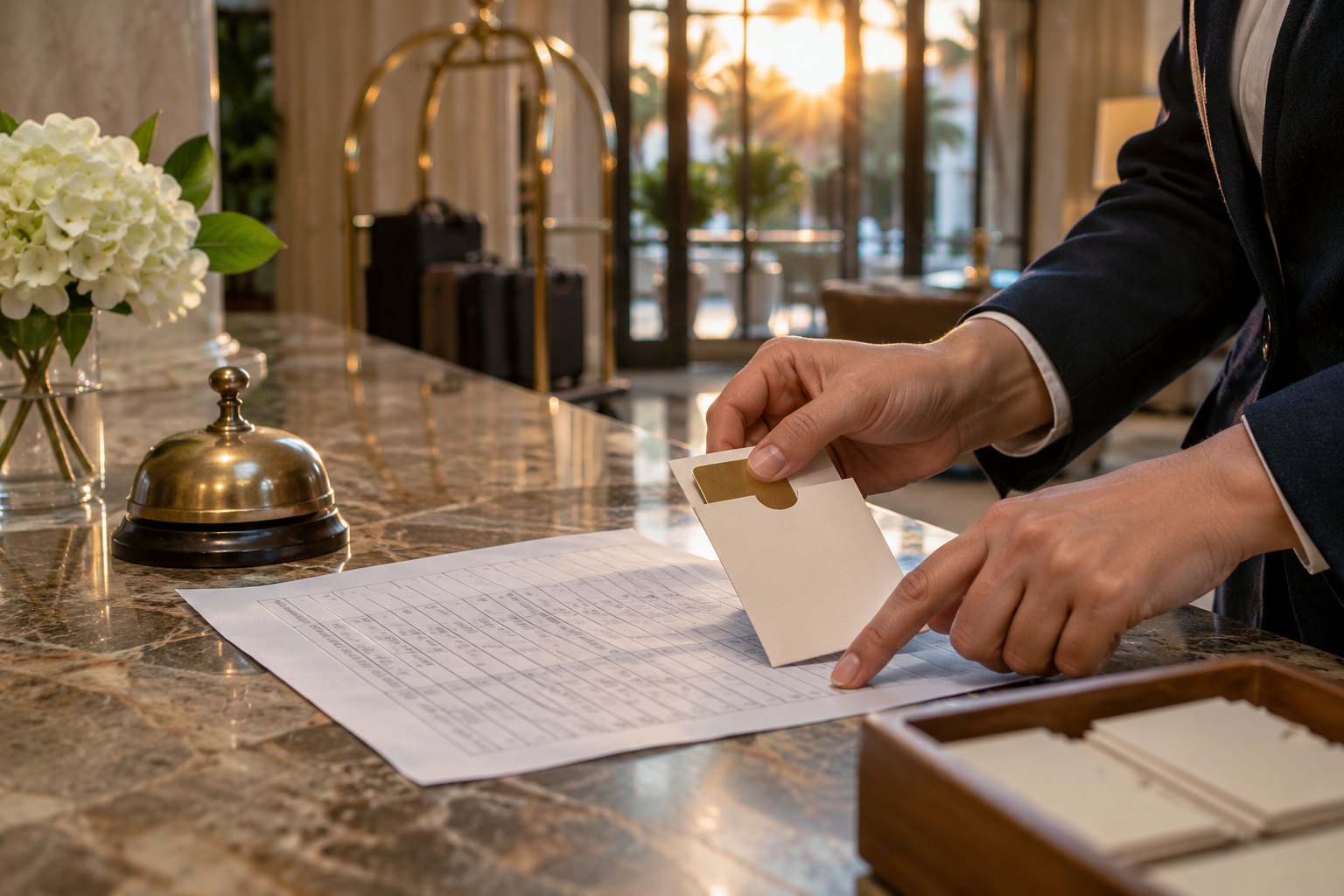
Start from accepted stays and room operations
A guest's confirmation may describe a room category before staff assign an individual physical room. At night the auditor needs to know the difference. Check what an operator can see about one upcoming reservation and the recorded room assignment. The example guest in 202 relies on an accepted stay and arrival instructions. A maintenance item in 311 is a condition of the physical room. Changing one of those records should not silently alter the other type of information. Use a neighbouring reservation for the same room category and ask how the system shows a reasonable way to assign it after an inspection.
Introduce a new arrival while the date process awaits an answer. Ask whether the property can check in the guest under the existing work procedure, or whether it must wait for a particular step. Expected behaviour depends on the operating model. Ask the vendor to show the exact background of a completed check-in including service date, booking identity and any payment work still open. It is useful to check whether a night worker can see the relevant room, confirm the guest's expected arrival and understand when another person must authorise a change. Keep examples anonymous and approved for the demonstration.
Choose one procedure for a late arrival and another for a no-show
Give the example team two records with a similar arrival time. One guest told the hotel they would be arriving late, while the other has not made contact. Ask the property to write the correct handling according to its policies and the applicable terms. A tester should be able to show what status each guest sees and what action staff expect. Record which events establish an arrival and whether a late notice appears in the next report. When contact is attempted or a case is assigned, capture the minimum detail necessary to help the following shift finish the work.
Use a test in which Friday becomes Saturday by local time while the business date is still awaiting an authorised step. Have the receptionist open one Friday arrival and one future Saturday arrival. The system should make the intended distinction legible. Test how the same situation appears in desk, housekeeping and audit views. A report needed for breakfast planning may use a different definition from the expected arrival list. Specify which system date, local date or service period each uses, and make sure the employees who depend on the feature can explain the name and meaning of the result.
Make adjustments visible to authorised reviewers
Ask finance to provide two small fictional cost references, one normal and one an adjustment that should not be routinely permitted at the front desk. Give the night auditor the correct role and check which step can be completed without a supervisor. A hotel can close out ordinary tasks more confidently if the product gives a trackable exception to someone with appropriate access. When an authorised correction is accepted, show the original value, changed value, reason and responsible actor in the appropriate records. Confirm that the closing balance and its supporting evidence can still be reproduced.
Use an external payment example with an inconclusive response. A staff member can see the earlier attempt and request a review through the usual process. Ask which system confirms the payment data and whether an external status should be expected later. Have a second worker open the booking during the wait. They should know that the original action is being checked and should not have to guess whether another charge was started. Test the staff view and appropriate guest view. An overnight reviewer needs clear help for the exact unresolved issue and a usable way to pass it to management.
Compare the product's annual and local settings by example
Availability, staff permissions and operating date behaviour may depend on configuration. Ask what needs to be decided for a property that has a restaurant, outsourced housekeeping and a reservation channel that synchronises asynchronously. Request the exact configuration tasks for the pilot property rather than accepting a list of product checkmarks. For example, an ordinary night audit may include separate reporting to the front office and restaurant accounts. Verify what is supplied through the same system and what depends on a contracted link or daily exchange. Identify a responsible person on both sides of every interface.
Prepare a known opening and closing balance in the fixture, with one payment settled after the operational day. Ask finance to reconcile the supplied entries. Do not copy another property’s accounting or reporting convention into the acceptance sheet. The chosen treatment is the hotel's decision. Test the distinction between an accepted charge, an unresolved payment attempt and a reversal under the expected permissions. See whether a report identifies the records its values use. An auditor should find the last report run, recognise a correction and know whether a later retry changed the outcome.
Compare reports by the questions staff ask at the start of the day
Give the opening manager a representative staffing situation. Several arrivals may need early attention, two guests have expected departures and a room remains barred from assignment until an authorised condition is met. Review which reports tell them what to do, and whether the actual quantity and dates are clear. At the same time give finance the closeout evidence without assuming that the operational count equals a financial movement. Match one opening activity to the accepted stay and one finance line to its origin. Keep the verification easy enough for a colleague joining after the system rollout.
Ask what support requires when a standard report looks implausible. Which filters were used? What business date did it apply to? Were actions still pending when it ran? Is the displayed report a saved artifact or a current calculation? Give test users two editions of the same report and ask them to identify the one that belongs to the accepted closing state. Test how each edition can be re-created after a permitted adjustment. Clarify what can be downloaded and who is responsible for sharing it with staff who do not have full property management access.
Test the housekeeping summary against a real condition change
In the example, someone finishes the inspection of 311 just after the initial report is created. The desk has to know when it is appropriate to reuse the room. Show the role authorised to confirm inspection, record its latest condition and verify how the information reaches the proper views. Report creation time belongs next to the current status. A desk employee needs a clear way to recognise that a printed note may be older than the accepted electronic condition. The change should not automatically modify unrelated guest arrangements, and the next shift should be able to identify the earlier hold.
Ask about an unexpected room move involving an occupied unit. Change the room assignment in the fixture under the hotel's approved process and keep the booking identity visible. Check whether services that were originally associated with the previous room need separate action. Verify expected cleaning tasks and which one remains with the original physical room. The night report should show which changes were made, the opening list should use the appropriate assignments, and the financial record should remain attributable to the correct guest. This gives the hotel concrete evidence about how the candidate handles real-life adjustments.
Inspect resilience during a bounded failure
Choose an interruption staff can replicate in the test environment. The property system might have to pause an interface or wait for a scheduled report. Ask the vendor to demonstrate the report queue, expected errors, restart authority and whether a completed action can be identified before retrying. Some work may have already been accepted before the process stopped. A good demonstration gives the auditor evidence of the system state and an orderly next action rather than a button that repeats all activity. Note the exact product, permissions and dependency used in each test.
Practise a shift in which an authorised employee must use an approved fallback for one check-in. Record the details the opening team may need to retain, along with the minimum procedure for reconciling the event with the official record. If staff are expected to use a local copy of the arrival list, confirm that it has a date and version and that the period of use is clear. Show the process for checking the correct reservation after restoration. Keep high-risk actions under the roles that can carry them out. Use the fallback during rehearsals without touching live guest or payment information.
Ask how logged evidence reaches support
Provide the vendor's support team with a demonstration incident containing an approved reference and timestamps. Which fields let the team identify the affected operation? Who can view full operational context? Can the night auditor identify whether a blocked close needs property information, a vendor action or an answer from an outside provider? Keep a short named escalation path that uses the same terms as the screen. Review coverage with the contracted support team and resolve unavailable paths before the pilot. This is especially useful at properties whose managers and suppliers work across different hours.
Observe whether the next-day shift can find a case without being the person who opened it. One question might be whether the prior night accepted pressing ahead with an expected report while a payment was still in review. The response should make the action, role and available evidence clear to a colleague. Establish whether the product can give the next employee an internal note, reference or actionable report link under its access rules. The shape of the handover has a larger daily impact than the number of administrator screens the vendor can demonstrate.
Build a selection scorecard around agreed observation
For each short-listed system, score the night case with staff doing the normal steps using test accounts. Verify the ability to review upcoming arrivals, distinguish the local date from business date, read a condition hold, match a payment event and reopen the last accepted report. Ask vendors to identify work that would require another product or configuration. Where a capability is still missing, record the dependencies and the responsible party. A useful scorecard shows whether the product supports the first hotel in the rollout and which assumptions need proof before adding another.
Compare training and cutover as separate items. Request a sequence for setting up a live property and a list of data that can be carried forward with its historic context. A former reservation may matter to an arriving guest even when it did not originate in the new application. Make a test version for staff and verify which fields can be entered or imported according to the approved scope. Ask the property owner who confirms correctness of imported rooms and open balances. Include a plan to maintain access to older evidence under the usual security rules after the product begins accepting new work.
Prove a contract milestone using the night audit fixture
Before a purchase, agree who will watch the exercise and what evidence is needed. The property manager can verify room status, the desk lead can verify arrivals and finance can verify its balances. Give each a written expectation for the same business day. If the test environment lacks a connected channel, identify what is simulated and what still requires an approved trial. A system is ready for the specific property when its staff can run the expected case, find its results and handle an exception using the promised features. Record the observed outcome near the vendor's proposed acceptance terms.
Finish with a second run by a relief auditor who did not design the test. Ask them to locate the delayed arrival, verify the extended stay and report why room 311 remains under review. Their answers should agree with the hotel’s current evidence under ordinary access. Give finance the accepted report and ask them to find the single payment that awaits review. Identify any point where the staff needed to ask the implementation team for a hidden label or reference. Correct that before relying on the same workflow at more properties.
A concise brief for a property implementation brings a known working set of roles, an overnight schedule, sample reservations, room conditions, payment outcomes and the handover reports. Choose one additional example that normally causes repeated work at the front desk and ask vendors to demonstrate it live in the test environment. By reviewing actual work before buying, the hotel can assess how the application manages dates and preserves the continuity guests and employees depend on, and can stage broader changes once the first site verifies the required result.
Decide which night-audit work can be automated
Distinguish a task the application can check against a known rule from a task the hotel expects a person to authorise. An automated report might list arrivals still outstanding. A front desk supervisor may need to review an unexpected record under the hotel's terms before another action changes it. Give the person reviewing the nightly sequence the exact scope of each automatic step and any blocking condition. If a scheduled job resumes after a delay, ask the vendor to show which steps already ran. The property should be able to tell whether the process was skipped, remains open or finished at another time. Arrange the callback and fallback procedures with the teams that will actually support the operation.
Test repeated work with an approved daily charge which appears twice in a simulated import. The auditor should recognise the original and the later attempt by stable evidence and know which amount is accepted. Ask what the product does if a maintenance restriction was lifted just before reports began but reached a downstream view late. Compare the signed handover and the current state. This exercise shows whether the property needs a source timestamp and a receipt timestamp for specific updates. Use only reports available to the two test roles so the result is repeatable by the desk and finance supervisors.
Read the first pilot against a deliberately ordinary week
Select two consecutive operating days with different arrival and checkout volumes. Ask the hotel to track which handover items reopened, which questions required support access and how long an employee needed to interpret any stop. Review those examples alongside the financial totals, and improve either procedure or software where a step remains ambiguous. Repeat the room extension and a late payment using the revised setup. The property should keep a version of the exercise with the approved changes, enabling another person to run it after a feature update. A representative week can also reveal differences between the way the product handles predictable and unusual work.
Close the evaluation with a readiness decision written in operational language. State whether the ordinary team can close a correctly prepared day, pass a clear work list to housekeeping, and recognise a pending exception that belongs to another role. Pair each claim with dated evidence and a reviewer. Keep unavailable capabilities in a small follow-up list with accountable owners. These conditions are more useful than a long catalogue of features when the hotel needs to decide how many rooms or sites to include in the first rollout.