
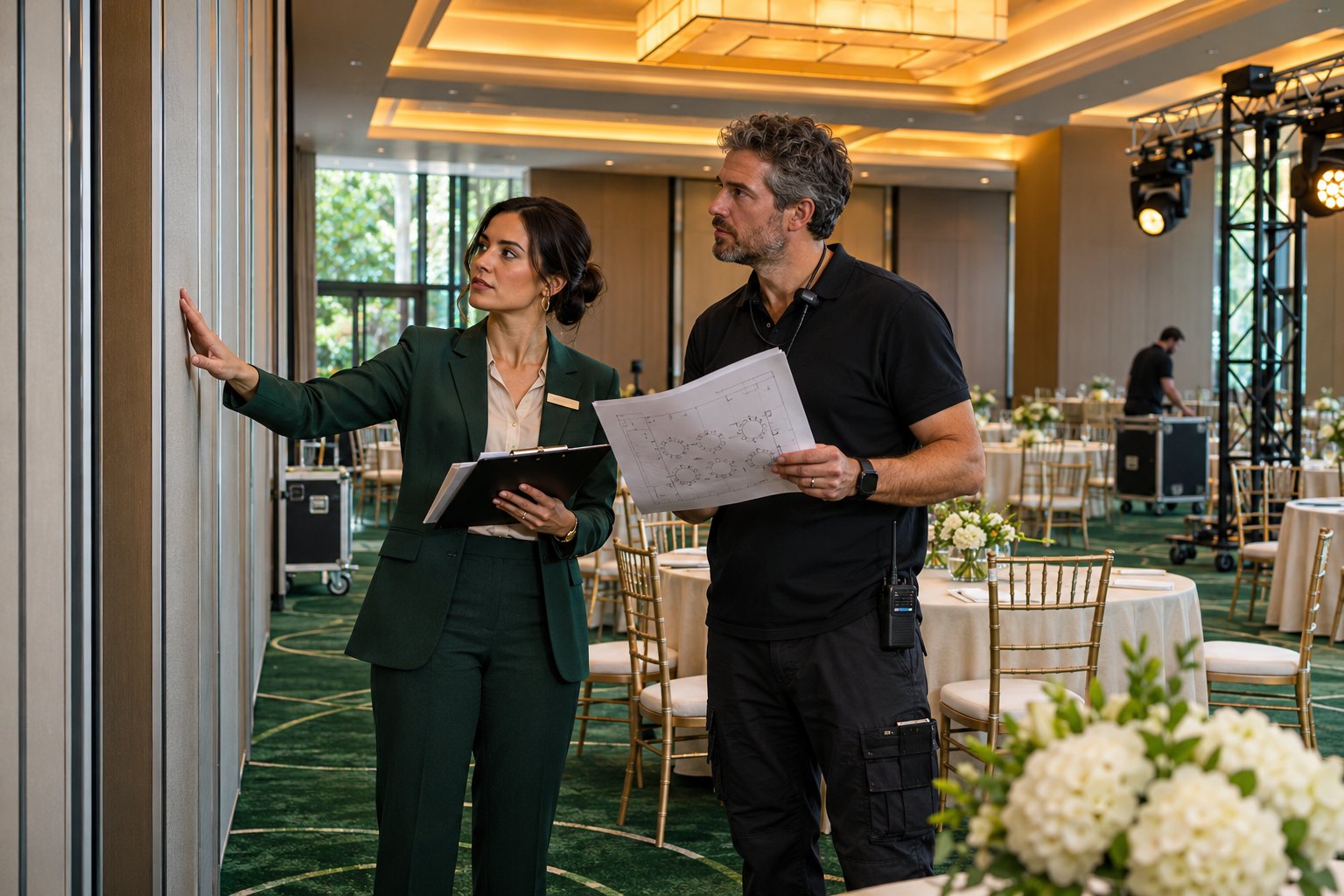
MICE solutions support meetings, incentives, conferences and exhibitions, but the name tells a buyer very little about which problem the software resolves. This guide is for an organiser who prices a programme, an event venue that supplies space and hotel rooms, and specialist partners that handle food or audiovisual needs. It focuses on the commercial commitments that change hands among them. A rooming list, meal guarantee and production plan may all describe the same event. They have different clocks, decision makers and financial consequences.
Imagine a two-day association meeting at the fictional Calder Hall Hotel. It has a block of guest rooms, two divisible meeting spaces, an off-site dinner and a live video session. The buyer wants to approve a single programme. The hotel's catering team needs a final guarantee, the audiovisual partner can only confirm the revised production plan after a site check, and the rooms desk needs to release unused block inventory under its own agreement. A useful workspace lets the planner see the obligations together without making the commercial terms identical. The figures and dates below are illustrative, not industry defaults.
Put the buyer agreement and each supplier commitment on different records
Create the event identity once, with an organiser, venue timezone, participant dates and named operating leads. If the programme includes more than one venue, give each service a local place and time. Beneath the event, maintain the accepted buyer quote, the room-block agreement, catering orders, production services and approved third-party commitments. A price shown to the buyer is not always the amount due to a supplier. Keep internal costs and expected margin in the workspace that needs to review them. A buyer should understand the quote's inclusions, exclusions and terms without seeing supplier rates that are confidential.
The Events Industry Council's APEX Event Specifications Guide is a useful example of the kinds of details planners communicate to event partners. ADMEI's description of destination management helps clarify why a local operating partner might handle logistics that sit outside the contracted main venue. Start with the agreements, schedules and operational packets your own people use. Neither resource determines your rates, contractual cutoffs or event requirements. Its value is making the kinds of records visible before the project begins.
Show whether a line is forecast, held or guaranteed
The association might forecast 140 dinners today, hold an event space for 160 and guarantee 125 meals next week. Each number answers a different planning question. A forecast gives suppliers an indication, a space reservation depends on a defined commitment, and a guarantee may trigger a cost. Store the source and effective revision of the number the venue is using. If the planner exports Monday's food order, the packet should not continue to display an obsolete headcount as a binding guarantee after it has changed. Retain the old version for the people investigating the variance.
Track conditions belonging specifically to each line. The rooms holding deadline relates to room nights by date and category. The catering guarantee might apply to a function or dietary breakdown. The technical production order can refer to approved requirements, access times and crew responsibilities in several venues. Let the administrator set which clocks trigger reminders and which events require explicit staff acceptance. Even where two cutoffs occur on the same day, the system should identify what changes if one is missed. Staff should not be expected to infer whether a generic “finalisation” timestamp applies to the hotel, the sound engineer or both.
Manage a room block across multiple nights and booking channels
A planner does not simply promise “50 rooms” at Calder Hall. The working proposal might hold 24 on Wednesday, 48 on Thursday and 36 on Friday, with a few configured rooms available only on two of those nights. Define what counts against the block when an attendee uses an authorised individual booking route or when group operations enter a rooming list. A hotel might also admit rooming changes through a supported existing system; identify how confirmed occupancy and inventory are verified. The event planner should not need to guess whether an imported participant name already created a booking.
Build a pick-up view that states what each number means. “Held,” “allocated to names,” “confirmed by the hotel,” “available within block” and “released” need separate definitions. Provide a reason and a source for late adjustments. A participant added outside the agreed route after a release may be separately booked instead of counted under the original terms. Where the contract defines attrition or unused capacity handling, the accounts staff need evidence of the applicable calculation and signed revisions. Avoid treating a sample calculation as a universally accepted charge or putting an estimated penalty on a public booking page.
Handle adjustments one night at a time
Suppose a Thursday rail cancellation makes twelve attendees extend to Friday. The front desk and hotel sales contact need separate actionable views. The desk can see which booked travellers request an extension; sales can see whether the room block admits extra nights and who can authorise a different rate. The planner can send an operational change request without the product automatically guaranteeing an extra hotel night. Ask staff to rehearse a failure in which a supplier acknowledges the request but cannot commit the requested quantity. The customer or delegate should see a clear result with the appropriate follow-up.
Keep the current hotel room list usable by authorised staff without making every export a security risk. A representative coordinating arrival may need headcount and pickup time; the lodging team needs the correct reservation details; an event sponsor generally needs neither. Design role-specific exports and a replacement mechanism for issued lists. If a list is emailed under an approved operating procedure, identify its date and revision, and keep a record of who received it. A removal from the event system does not reclaim a previously downloadable copy, so practice how staff retire obsolete lists.
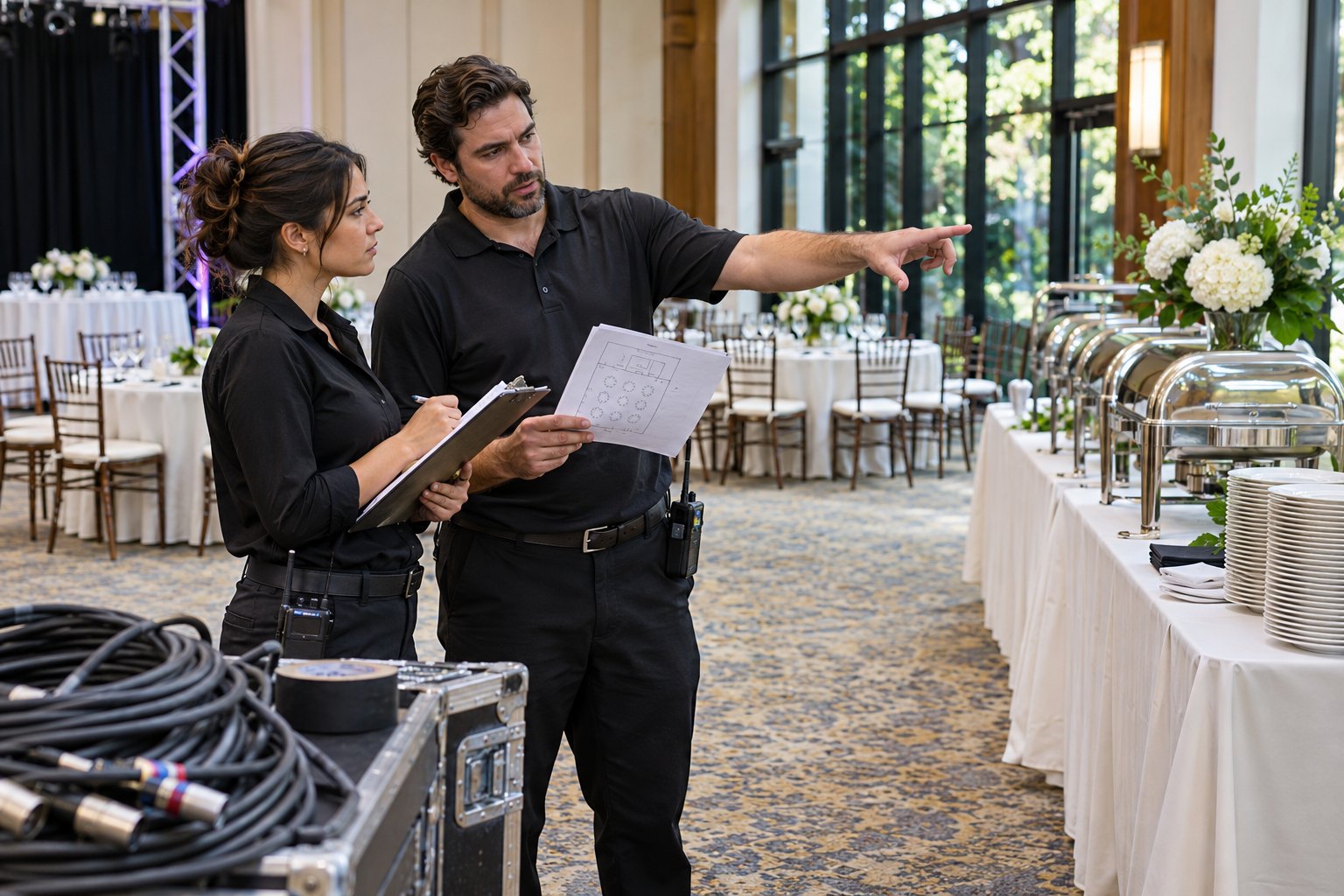
Prepare proof for catering and audiovisual handoffs
Catering staff need more than the number of registrations. Attendance at a workshop dinner, speaker hospitality and crew meals may have different commercial owners. On the function record, capture service windows, access and setup times, agreed quantities and relevant approved special requirements. Keep detailed personal information out of broad exports. For a dietary or other practical requirement, consult the people authorised to handle it and pass only what the service partner needs by the agreed route. A public organiser note should not expose the details attached to an individual meal.
A production team wants a list of what it must lay out and test, along with who supplies each input. Separate hardware, connectivity, room access and crew tasks so a video session can be restaged without rewriting the buyer's whole programme. If a sponsor adds an additional speaker, identify whether that changes staffing, microphones, recording permissions or a technical access window. The change can be accepted at one level and still need supplier confirmation. Produce an issue list that states which setup change is waiting, the responsible party and the time by which a decision will affect the rest of the event.
| Event line | Value being agreed | Evidence the delivery team can verify |
|---|---|---|
| Guest-room block | Rooms by night and category, and scheduled hold or release | Current venue allocation and the applicable signed terms |
| Banquet service | Meal guarantee, setup and approved exceptions per function | Named venue acknowledgement of the catering order revision |
| Audio and video | Technical configuration, access, operating hours and crew hours | Approved production package, start time and staff assignment |
| Local transport | Pickup route, permitted capacities, vehicle type and contacts | Assigned provider confirmation with exact times and meeting points |
| Client quote | Approved programme scope and price conditions | Accepted buyer revision with document delivery evidence |
When a function order is approved, give each recipient a short operational document relevant to the role. The hotel kitchen needs the right guarantee and delivery time, the room team needs the approved interpretation of the floorplan, and technical crews need the load-in times and verified inputs. The document should name the revision it reflects, the activities it covers and which source retains the current version. If a supplier has an existing agreed order format, adapt it to the data and evidence available rather than forcing a duplicate acknowledgement with ambiguous status.
Use a signed revision rather than an editable final number
Run a change through the working prototype. The organiser originally approves 110 dinner covers. Three days before the evening, the buyer requests 12 more and adds a short award presentation. Capture the request with a budget owner. The catering team confirms whether it can deliver 122 covers on the approved menu and at what charge; the production team decides what technical consequences the presentation creates. The organiser can then approve a consolidated proposal for the relevant difference. Retain the original 110 guarantee and separate supplier acknowledgements. If the new buyer price is rejected, the software should have a clear state for the last accepted operational instructions.
Prepare for a venue that confirms by telephone when a reception is busy. An authorised staff member can record a time, the contact, what was stated and the effective service version. That note should be distinguishable from a confirmation the supplier entered or signed directly. If the venue later emails a conflicting order copy, open a review without clearing the posted plan. Handle conflicts based on the agreement and current owner rather than the latest file timestamp. Talk through exactly what the app should say to the people setting up the room while that discrepancy is being resolved.
Build a finance path that preserves quote assumptions
The buyer's quote may combine fixed planning fees, variable per-attendee lines and specialist charges due after the event. Ask your product team to demonstrate how changing one guaranteed quantity affects the quote floor and forecast margin without repricing unrelated lines. If supplier commitments are in more than one currency, preserve the original currencies and the assumptions used for any commercial estimation. A manager can approve a particular margin exception with a clear rationale, but the UI should distinguish a budget planning calculation from a final accepted amount. Use a fixed sample quote to verify the difference.
Capture actual labour, added services and incidental fees at the line appropriate for settlement. Venue crews may record additional time while buyer approval is pending. An activity can be delivered without a confirmed billing outcome. Finance wants the supplier statement, the original cost basis, the adjustment request and what the client approved, preferably without opening a separate chat for every charge. A clean reconciliation view will show charges that match, open approvals, disputes and items that were not billable under the supported agreement. Only authorised staff should confirm a new payable or issue an adjustment.
Don't make the financial team guess whose decision a status represents. If a catering invoice shows 126 meals after 122 were approved, keep counts accepted, actual and invoiced distinct. A supervisor might record four extras that were served; a separate reviewer should decide what the contract recognises and whether approval was needed. Use source-based adjustments and preserve the longer history for both supplier discussion and buyer explanation. Commercial service evidence should be detailed enough to be useful without collecting personal attendee facts irrelevant to accounting.
Give each on-site lead a compact working view
The technical lead at a loading bay wants the approved access time, assigned tasks and a contact method. The host at registration wants to know where to direct arrivals and how to handle duplicates. The planner wants reminders for unresolved meal and room-block commitments and a quick way to compare document revisions. Support those views from the same source, but do not demand that every user inspect the entire event. Rehearse with a phone using intermittent venue Wi-Fi. Have a staff member open the latest relevant directions and confirm where to check for changes if connectivity is lost.
Track service dates with local time and relevant revision numbers. An off-site dinner departure can move after afternoon sessions overrun. If the change is authorised, notify affected roles and record who accepted and when. Staff at the wrong venue should not receive an alert with vague location text. On duty handoff, show critical unresolved items by their assigned owners, such as a changed room mode without a venue acknowledgement or a bus waiting for an assembly point. Allow professional judgement and an explicit note when someone needs to act before the formal service update is complete.
Run a venue-to-organiser acceptance exercise
Use sample records and two devices. A venue employee reports that a partition cannot move at the planned time. The planner needs to understand which session layouts are affected, the difference between a proposed replacement and an approved one, and who will explain revised instructions to the host. The accounts reviewer asks whether any supplier charge changed. Give a staff member a printed version with an older room plan and confirm they can identify the stale revision. A software demo should help each role locate the evidence they need without giving them the privileges of the overall event administrator.
Do a second exercise around a change that doesn't affect the quoted commercial total. A hotel desk marks one room's booking reference corrected, and the new value appears to the rooming coordinator without editing cutoffs or a participant's accepted price. Compare the time of the update with the emergency sheet that was already printed. Give the team a safe process to notify anyone holding an old operational packet. If the staffing lead can only deliver the revision using a general spreadsheet shared with unrelated volunteers, the product is not ready for a real event.
Use a third exercise to assess whether planners can explain the last agreed guarantee. After two counteroffers and a late request for four extra covers, ask a duty manager to find the supplier's effective revision and the buyer's accepted amount. Set the training environment so one team has already approved its part and another has not responded. A successful operator should answer what is agreed, what remains uncertain and how to reach the next decision maker without asking the developer to inspect backend records. Write the resulting status definitions into handover notes.
Design the commercial freeze as several events
Ask the organiser to draw timing on a sheet with separate lanes for the room block, dinner, main venue and production supplier. Put the buyer's approval milestones on an additional lane. If these suppliers all freeze different values on different days, one hard stop in the application is too blunt. A meal guarantee shouldn't freeze a guest name, and a hotel room release shouldn't prevent an already approved production vendor from correcting a loading dock contact. Define how late edits can still be requested and which staff can approve them. Make the resulting operating policy visible in the prototype.
Give the buyer a budget view that shows the quantity submitted, price condition and current acceptance status for each impacted line. When the headcount changes, explain which kinds of costs can change and which figures are estimates. For example, one late speaker may affect equipment and room access more than the meal guarantee. An authorised planner can build a costed comparison without automatically promising the new scope to the attendee. When the buyer authorises it, the system should generate a clear accepted quote revision whose finance impact can be reconciled against the appropriate supplier confirmation.
Require staff to explain the reason an outstanding approval cannot be closed. A tab with several lines marked pending is insufficient when a venue will lock its kitchen numbers that afternoon. Establish whether the supplier hasn't seen the request, can't provide the service, needs an updated floor plan or has made a counteroffer. Capture decision notes where they can describe relevant context without copying a complete message into a finance record. A reminder can group all work for the same person but should not make them approve three unrelated items as a single transaction just to clear a notification.
After the event, compare the time and money impact of each important revision with the assumptions used in the sales quote. A quote was reviewed at a particular headcount under a proposed programme; the completed event might use different room nights, catering or crew hours. Separate paid changes, included changes and unresolved adjustments. Spend time on exceptions staff could prevent next time, such as wrong dates on a distribution export or a missed service acceptance that led to an emergency additional charge. A lesson tied to a record and an owner is more actionable than a general note that the event was complicated.
Make the acceptance criteria portable to the next buyer and venue without assuming the same event model. The next venue might handle rooms and catering together but use outside production contractors, or the buyer might keep some of those costs outside your agreement. Start with ownership and evidence, then adapt the terms and labels. A platform earns its place when the organiser can explain who agreed to each obligation and a supplier can verify the exact job without reading the whole contract. Review this with actual event team members before asking them to abandon a working handoff.
Deliver a small programme first
Pick one realistic event with lodging, food and a third-party service and decide how each party will receive the approved version. Agree what can be imported from existing platforms and which records should stay authoritative there. Set up controls around guest lists, revised deposits and after-hours work. Walk through a formal supplier review and a field exception before allocating extra modules for venue sales, online registration or complex billing. A pilot focused on one shared commitment produces evidence about whether a larger roll out will help your team.
When briefing TravelTech365, bring one redacted event order, sample room-block dates, an approved quote revision and a settlement example with an adjustment. If the rough framework already exists, show the particular handoff the team cannot explain today. The MICE management software guide covers a broader operational view. To focus on the venue and supplier commitment workflow, share your event requirements and identify whose systems and approval responsibilities need to be included.