

Give the train module a record for each part of a rail journey
A train module helps a travel business assemble and service rail journeys that may span several departures, tickets, operators and locations. A traveller sees one itinerary, but the team needs to distinguish permission to board each train, any seat reservation, the physical connection and the contact that can review a change. Start with the evidence behind each leg and keep it accessible through the whole journey. This structure makes a changed connection easier to explain without assuming that all tickets carry the same conditions.
Choose the operating product and the supported sale scope. A direct journey can be easier to support than one involving two providers with independent terms. Document what a shopper sees before accepting, how the service provides valid boarding evidence and what staff can verify after purchase. Name which provider's current information applies to each stage. Confirm actual contractual responsibilities with the relevant supplier and business owners.
Distinguish scheduling information from a ticket commitment
The GTFS Schedule reference describes a way to publish transit schedule information, including trips and stops. It can help a team represent a planned journey. The actual booking source provides accepted ticket and seat evidence when those services are offered under its scope. Keep schedule and reservation facts connected with identifiers and local dates while distinguishing which source can supply each result. Do not turn a planned departure into a claim about boardable inventory.
Eurostar's connecting train information illustrates that details and handling can differ across connecting journeys and their ticket arrangements. Check the actual operator and ticket conditions for the service you sell or support. Design the module to preserve which tickets and operators are involved and what the permitted help route is. An itinerary sold or presented together does not establish a universal recovery outcome.
Rehearse a connection between two separately serviced legs
The fictional Marsh Junction itinerary includes a first train arriving at 11:10 and a second departing at 11:43. The test traveller can walk between two parts of the station under the exercise conditions. The first and second train use different provider references, and the second requires a separately verified place record for this example. A late report means the first train may reach the station at 11:37. The travel team needs to identify what is still valid and who can review any change.
| Item | Fixture detail | What the team needs to verify |
|---|---|---|
| First train | Planned 11:10 arrival, later estimate 11:37 | Correct service occurrence and most recent verified timing |
| Connection | Second train scheduled for 11:43 | Relevant station path and timing for this particular route |
| Second train ticket | Separate provider reference | Applicable ticket scope and permitted assistance path |
| Seat or place | Provider evidence applies to the second service | Current assignment and whether the operator must approve a change |
| Customer update | Earlier joined itinerary still visible | Accurate local dates, support contact and confirmed arrangements |
The new interval is six minutes in this fixture. Give the team both times and let it use its documented policy and provider advice. The original 33-minute interval and the revised six-minute gap describe this synthetic trip, without setting minimum transfer times for actual rail services. Verify platform details and any appropriate travel support before asking the person to choose another option. Do not automatically move the second leg on the basis of a prediction from the first.
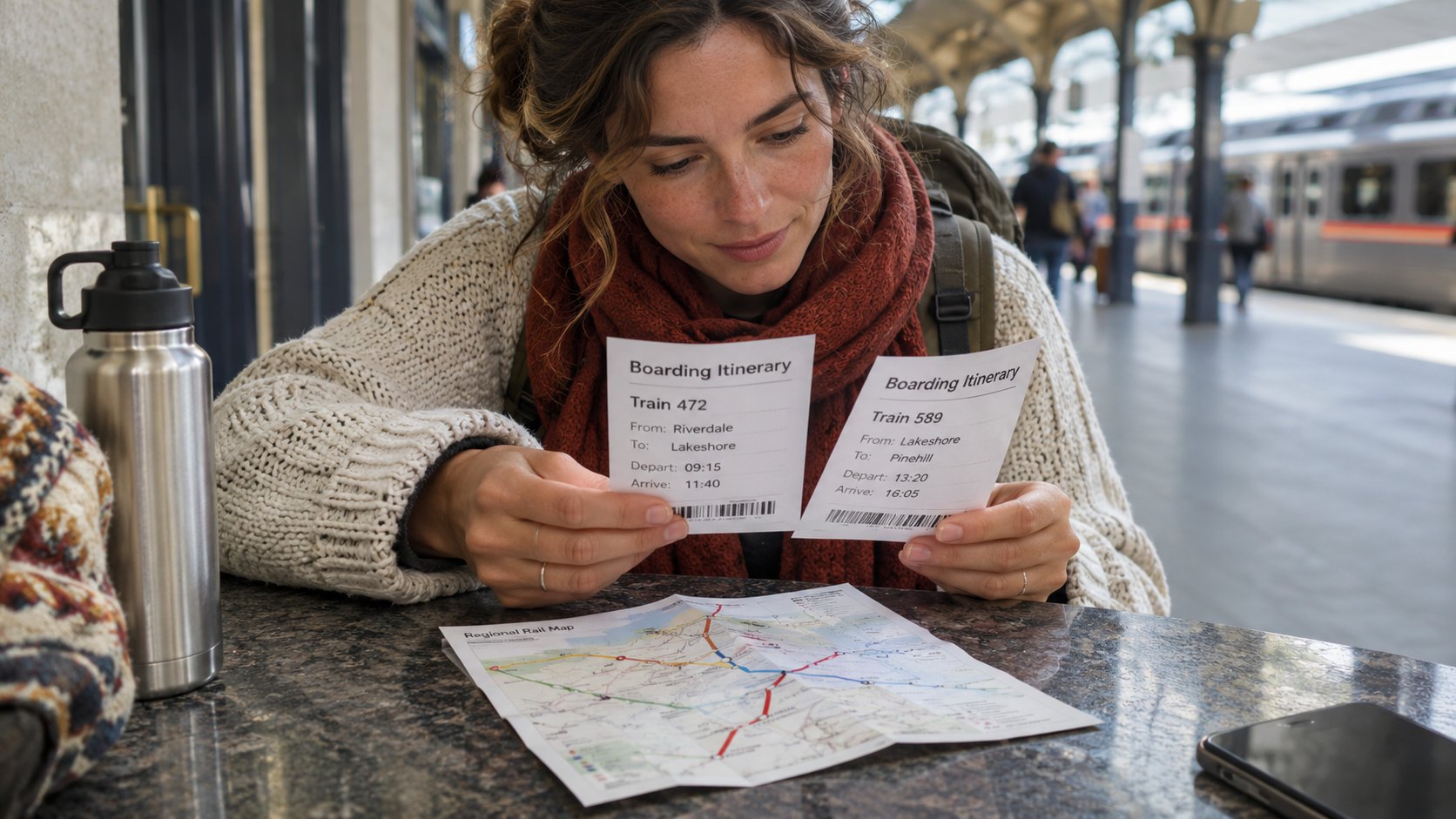
Keep leg identity stable when a schedule changes
A route can operate many times under the same service name. Establish which operator, service date, station sequence and departure apply to the current itinerary using the approved identifiers. A delay report mentioning an earlier train may look similar from a display label. Compare the affected occurrence before updating the traveller's instructions. Give reviewers enough evidence to distinguish a new time for the existing train from a new proposed service.
Store the original advertised schedule and the latest reliably observed state. The traveller should be able to identify which time is current and what is estimated. A member of staff may also need to see the time the source posted an update. Preserve both the service location and calendar date. Some connections cross midnight or happen between nearby stations, so a time without its local meaning can make a valid ticket harder to use.
Keep the trip readable when tickets and seats are separate
Give each relevant service a confirmation or supporting document under its actual provider process. A boarding element may apply to the whole journey or a single leg, depending on the accepted arrangement. Use the actual ticket evidence and reference. An available seat map during shopping does not prove a person holds a particular place. At fulfilment the module should show which travellers have place evidence where it is required.
Try a party with two travellers and the first only needing to change one leg. Identify accepted authority and check the ticket scope. A change may need the original provider or seller to evaluate whether it can proceed independently. Keep both the original and revised decisions traceable. In the customer itinerary mark which ticket or seat evidence has changed and which remains valid. Avoid treating an unconfirmed alternate as boardable.
Preserve a usable route through the station
The station might be represented by a city, a complex or a precise stop. Verify the actual change point and whether the traveller needs to walk, transfer or leave one ticketing area before entering another. Use approved station information and give users a practical contact for assistance. If only tentative platform information is available, tell them which source to check before departure. Store the route and boarding instructions appropriate to each accepted service.
In the Marsh Junction fixture, let staff review a transfer where platform directions change but the operator's booking scope remains identical. The updated note can explain the path without changing the underlying ticket. Then try a real change to a different departure. Retrieve the applicable supported terms and the confirmed new document if available. The two events should not follow the exact same state merely because both adjust the displayed itinerary.
Handle timing and remedies through approved operating authorities
Give staff a way to name the affected service, supplier reference and contact. A train status source can indicate an operational update. The actual rail seller and provider determine what changes or recovery can occur under the applicable terms. The traveller may need to ask a station worker or contact a separate authorised seller. Design a clear route to that help without broad assurances about fees, ticket rights or seat availability. Check advice directly for the itinerary being served.
Test the first service arriving late enough that the connection may not be workable. The case owner confirms which leg is affected and whether the provider can offer another option. An accepted replacement may alter departure, arrival and offered place. Review any planned onward service, and let the person responsible check it separately before telling the traveller what is still available. Record the source of each confirmed change and the relevant times.
Review separate ticket scope when only part of the journey changes
Ask the operator what belongs to the same contract or permitted service model before designing customer guidance. The module can show an entire route while retaining distinct evidence and help options for each purchase. If the customer bought an additional return with different terms, preserve the original accepted scope, even when they ask about a new outbound connection. A staff member must be able to retrieve the accurate documents without assuming a change affects all orders on one screen.
Use a fixture with an outward replacement and an unchanged return. Give the employee the original outward reference and the new accepted result. Verify what remains valid for the return and whether any customer notice should mention it. The form can record why it is unchanged without requiring a new booking. Give the traveller a usable version of the itinerary and appropriate help path for any unresolved part.
Separate traveller guidance from the operator's case file
Give the traveller one reading order. Show the affected itinerary first, the latest instruction second and any action they must take third. A confirmation can then retain the full route underneath for reference. In the example journey, an estimated 11:37 arrival must be marked as an estimate with its source time, while a confirmed replacement departure must use its own service and seat details. Put timestamps next to the specific information they qualify. A single refreshed timestamp at the top of a screen implies that every leg has been checked, including the return which nobody has reviewed.
Give employees a different view based on the same data. Their case file needs the source of each message, who took ownership, which options were offered, which instruction the traveller accepted and which ticket the provider issued. Employees should be able to read a short summary without opening every attachment. The summary should reference the records it came from. If a supplier email contradicts an event received through the reservation connection, both remain visible until the employee records the authoritative resolution. Avoid allowing whichever update arrived last to overwrite a decision that depended on two records.
Test the replacement message with the traveller's original receipt
Ask someone who has never seen the itinerary to read the original receipt and the replacement in sequence. Give them three questions: where to board, which service to take and whether their original return is still available. Note the first place they stop or switch between messages. If the answer depends on remembering a carrier abbreviation or scanning a footer, update the replacement before adding another reminder. When passengers receive a printed itinerary, a forwarded email or a mobile ticket, they may only have one fragment of the conversation in front of them at the station.
Use link text that describes its destination, especially where cancelled and active documents appear close together. Put revised boarding information in text alongside any icon or colour. Include the service date, because searches and notifications can refer to the same time on consecutive days. Provide a short fallback instruction if details are still being checked. Format the latest update so a person can distinguish a possible route from the route they should follow. Those are two different operational states even if both look plausible on a timetable.
Design data updates around what can be recovered
Define which messages can be applied automatically and which must be reviewed. You might update a display-only estimate when a well-formed message identifies the affected service. Replacing a ticket could require stronger evidence, such as the provider returning a newly issued document that the employee can match to an accepted option. A notification without a reliable itinerary reference should enter an investigation queue. These choices belong in the integration brief, next to examples showing where the new information comes from and which fields may change. They affect the work that remains for customer support.
A scheduled update and a ticketing update solve different problems. The first describes what a train is expected to do. The second describes what the traveller has been issued. When designing a client view, keep each source visible to the staff who must respond and use language that makes the distinction clear to the traveller. If a replacement is accepted before issue confirmation, preserve the acceptance timestamp and show the ticket status separately. A configuration that allows duplicate issue attempts needs a way to detect the original transaction before someone retries it from another screen.
Test one failure at a time and then combine them
Prepare test messages where a new departure estimate arrives after a cancellation, where a confirmation is duplicated and where an older update arrives after the incident was closed. Give each a known expected effect. For example, duplicate confirmation of a replacement should leave the passenger with one usable replacement and one clear case history. Reopening a closed episode should require an explicit, attributable change such as a new cancellation or a human review decision. Combine scenarios only after the team can explain why the outcome of each single fault was correct.
Also test a partial outage around a useful transfer. In this scenario, the rail information source is present but the reservation provider fails to answer. The traveller's screen can preserve the timetable estimate and mark replacement as pending. The employee needs a clear record that an attempt was made and an action they can take if the provider remains unavailable. Give sample data to the support team, then ask them to reconstruct what happened using the case alone. Treat unexplained gaps as design work.
Set acceptance criteria with the service desk and finance team
For support, measure how long a colleague takes to reconstruct what the traveller currently holds, using only the tools they will normally have. Capture whether they selected the same next action as the duty supervisor. For product, check if the traveller can read the case outcome without repeatedly reopening the itinerary. For finance, ask whether an original payment, an additional amount, a proposed adjustment and a confirmed refund can be distinguished. An adjustment can arrive after the traveller is already on the replacement train. The case can be operationally resolved while a financial item still awaits a decision.
Walk through a case where no change is issued. The specialist may find that the late estimate was corrected in time and that the original connection can still go ahead. Give them a way to close the review with an explanation, keep the existing documents and notify the traveller if an earlier message prompted them to wait. This path helps prevent an exception queue from driving needless changes. Count cases in which the team acted and cases it monitored. Measure the two separately during the trial so product managers know what people actually used the module to do.
Give investigators a bounded timeline
Put the original itinerary, the first disruption signal, each accepted state change and the final delivery outcome on a chronological timeline. Include the timestamp recorded by the source and the timestamp at which the module received it when both are available. Make it possible to look up one precise journey through an internal identifier even if the carrier changed its own reference. The support team can provide a useful answer faster when it can read those entries without receiving a separate export from engineering. Restrict sensitive details to staff who need them for that case.
Include a quiet handover test. Use an evening disruption where the first employee leaves before the provider confirms a changed service. The successor should find the current owner, the current offer expiry if any, the last information sent to the traveller and the next promised update time. Ask two employees to open the same case and try to take conflicting actions. The workflow should make clear that one person's work must be reconciled before the other action proceeds. Write the expected handling in the project acceptance brief.
Plan a small launch around one connection family
Pick a corridor with enough useful complexity to exercise the design. A connecting trip may involve a station change, a low-frequency second leg, assigned seating or different support ownership. Choose a single complication the pilot can represent reliably. If a nominally similar corridor needs another set of rules, keep it out of the first release until the operator can review it. Add a route only when the team can identify its source of data, its profile transitions and the staff responsible for exceptions. This gives the launch team a concrete way to decide whether a corridor is ready.
Before the pilot, list the traveller formats you actually distribute, including status emails and printable confirmations. Agree which event will prompt a message, which staff can resend it and what they should see when delivery is unresolved. Test one connection with a short first leg, one starting late in the day and one return sequence where the return must stay in the itinerary after the outward change. Ask for operational reporting by scenario family. Total bookings alone can hide whether agents ever saw a tight transfer case.
Record what you intentionally defer
The first release may show only the operator response for a limited set of ticket types. Record how staff will redirect the traveller when the booking falls outside that set. For each deferred item write the missing dependency, who would confirm it and an example that demonstrates why it matters. A requirement like “support one additional rail connection provider” is easier to review if it includes the test evidence expected for revised tickets, a single traveller with multiple legs and a clear record of usable seat information. A team can then decide whether these conditions belong in the next release.
Run the case a second time after recording those limits. Start at search, accept the two legs, record a delay, make a replacement decision, send the update and hand the record to finance. Repeat with no replacement and a separate document failure. Keep the evidence where product, support and engineering can each use it during future reviews. When a carrier update changes an assumption, revise the test and identify the journeys that could need a refreshed classification.
What to include in a connecting rail development brief
Bring one anonymised rail journey with its stop sequence and service dates, one set of tickets and seat documents, one incident that forced an operational decision and one support message that travellers actually used. Add a plain statement of where provider responsibility begins and ends for the example. Ask the team to map those items to the itinerary view, the case file and the inputs needed from each source. That gives a train module for connecting rail itineraries a verifiable first release based on known journeys. Build future examples around the support questions that arise during the pilot.
Before signing off the brief, ask the duty manager to select a case from a different shift and attempt the same reconstruction without help. If a decision only makes sense after a developer explains an internal status, improve the staff wording and test it again. Record the successful exercise with the release documentation, including the example date, the supported corridor and the known limits of the reservation supplier. That evidence gives the next person a starting point when schedules change or a second corridor comes into scope.